.svg)
Solutions
Features
Resources
.svg)
Trusted by 2,000+ operators
"Whether you have a smaller listing count or a larger one, Uplisting is easy to use, and it's scalable."
Josh Kristoff
Nomad Capital Adventures

4.8/5

4.9/5
Log in to your account
"Whether you have a smaller listing count or a larger one, Uplisting is easy to use, and it's scalable."
Josh Kristoff
Nomad Capital Adventures
Log in to your account

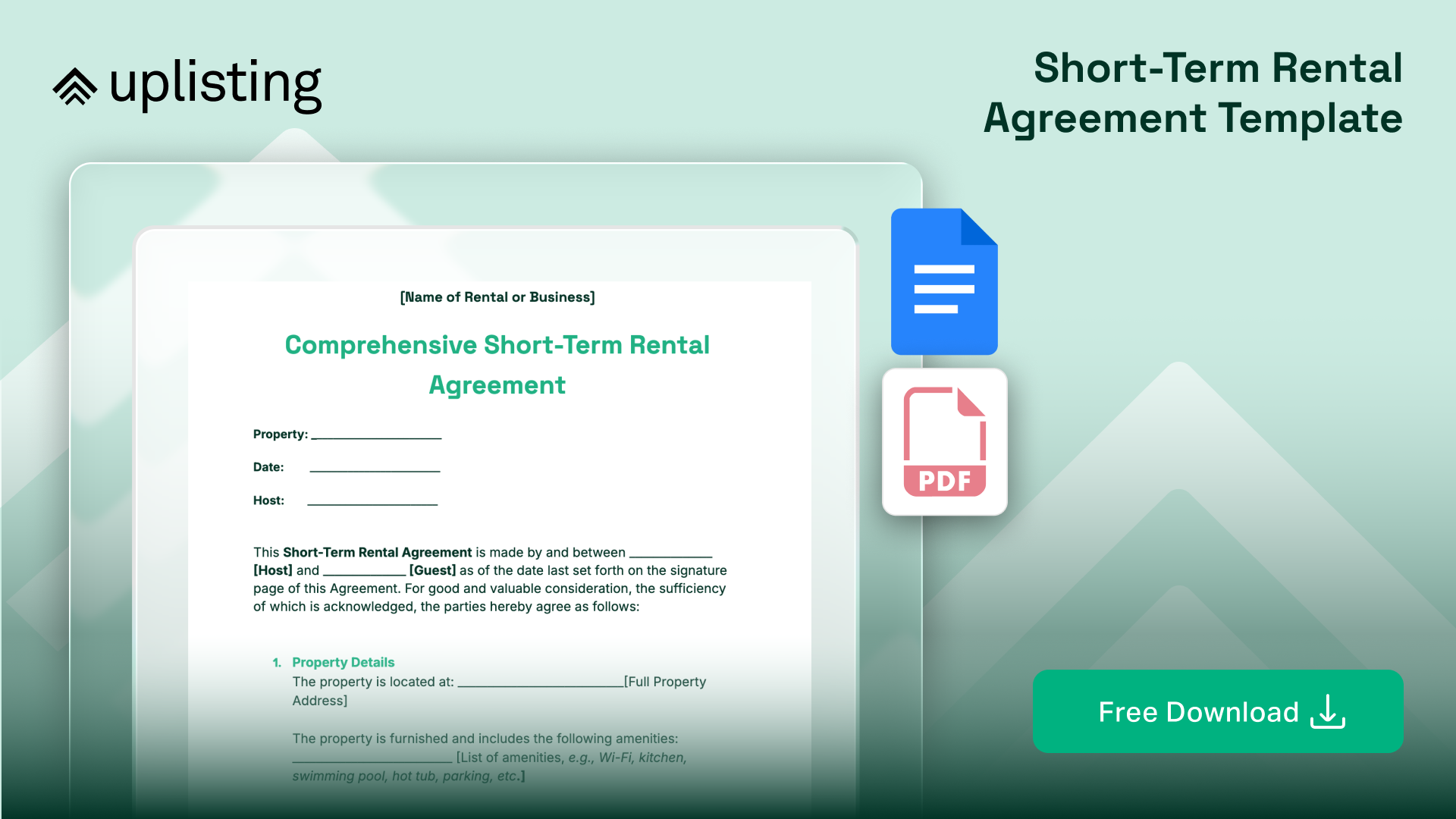
If you want a simple way to formalize bookings without adding admin, this free short-term rental agreement template is ready to use.
Customize it once and reuse it to set clear expectations for every stay.
Running short-term rentals means juggling a whole lot, including guest bookings, turnovers, and the steady stream of questions that pop up. Even with a trusted booking platform in place, gaps remain when it comes to protecting your property, setting expectations, and handling direct or longer-term stays.
That’s where a clear short-term rental agreement steps in.
Rather than relying on assumptions or scattered messages, a written agreement puts everything in one place. It sets expectations upfront, protects both hosts and guests, and reduces the chances of misunderstandings later on. This guide breaks down when these agreements are worth using, what a practical, host-friendly agreement should include, and how to apply our free, ready-made template without adding more admin to your day.
Everything here is written with real-world hosting in mind. The goal is simple: help you spend less time dealing with paperwork and avoidable issues, and more time running smooth, well-organised stays with confidence.
A short-term rental contract gives structure to a stay before it begins. While booking platforms handle reservations and payments, they do not always cover the finer details of how a property should be used, what happens if plans change, or how issues are resolved when something goes wrong.
For hosts, a contract helps set expectations clearly and early. House rules, occupancy limits, check-in and check-out times, and responsibility for damages are easier to enforce when they are written down and agreed to in advance. This is especially helpful for longer stays, higher-value properties, or bookings arranged outside of a platform.
Contracts also reduce misunderstandings. Guests know what is expected of them, and hosts have a clear reference point if questions or disputes come up later. Instead of relying on message threads or assumptions, both sides are working from the same information.
For direct bookings, a written agreement becomes even more important. Without platform terms to fall back on, a contract provides clarity around payments, cancellations, and property use. It creates consistency across stays and helps hosts manage their rentals more professionally, without adding unnecessary complexity to the process.
Longer stays bring even more red tape. In the United States, anything over 30 days can mean tenants’ rights get triggered, while in Europe, tax and zoning rules pile up fast. For those bookings, a written agreement goes from “nice to have” to non-negotiable. Short-term rental compliance matters for every host who wants to avoid steep fines and legal headaches.
The right contract keeps you covered, so you spend less time worrying and more time welcoming guests.
The more variables a booking introduces, the more valuable a clear, written agreement becomes.
While not every stay needs one, there are several scenarios where having a signed agreement moves from “nice to have” to genuinely useful.
In some cases, using a short term rental template isn't compulsory, but it's recommended anyway.
For some situations, a short term rental agreement is a non-negotiable, and hosts are putting themselves and their property at risk without one.
One of the biggest reasons hosts avoid rental agreements is uncertainty about what they should include. This template removes that guesswork by covering the essentials, without locking you into rigid language that doesn’t fit your hosting style.
Here’s a quick walkthrough of how the template is structured.
The key thing to know is that the template is intentionally modular and editable. You can customise sections to suit your location, booking type, or property style, then reuse it across future stays. It’s designed to support your hosting workflow, not complicate it.
Get the free short-term rental agreement, covering everything from occupancy limits to cancellation policies to house rules. Make sure you and your guests are on the same page from the moment they book.
Clear, thorough contracts keep surprises to a minimum and help everyone walk away satisfied.
The right short term rental agreement template spells out who’s responsible, what’s expected, and how every stay will work, with no guesswork and no gray areas. The below is already included in our free, downloadable template, but if you're starting from scratch, this is a great place to begin.
List the host and the main guest, using full legal names.
Specify who books, who stays, and who covers any damages or violations. When additional travelers join, the agreement should call out each name and clarify that the listed guest takes full responsibility for every member of the group. If a lamp gets smashed or a noise complaint rolls in, you know exactly who’s on the hook.
Write out precise start and end dates, then detail check-in and check-out times. If you allow early arrivals or late departures, spell out how guests can request them and what extra fees apply. By setting the schedule in black and white, you’ll avoid awkward early knock-knocks or last-minute requests that send your cleaner scrambling.
Break down the full rental price, when funds are due, and how payment should be sent—whether by PayPal, Stripe, or bank transfer.
If you require a deposit, lay out when it’s due and when the balance must be paid. A payment calendar, paired with accepted methods, keeps everyone organized and ensures rent lands in your account on time.
State the security deposit amount and make clear what counts as refundable.
Tie the refund timeline directly to the condition of the property at check-out. If something gets damaged, lost, or left in a mess, you have a built-in process for deductions and refunds.
Rules prevent headaches. Quiet hours, pet allowances (or bans), occupancy limits, and smoking restrictions should all be listed in the agreement. Our template includes an Exhibit A section, which lets you specify expectations around noise, parties, and respectful conduct. When guests sign, they agree to those rules and you have written proof if a dispute pops up.
Write out exactly how much guests get back if they cancel, and how close to check-in they need to decide. Include language for last-minute emergencies, so you’re not left holding the bag when a no-show leaves your calendar empty. The template lets you choose the refund structure and cancellation policies that work for your business model.
Make clear that guests need their own travel insurance and understand host liability limits on your vacation rental insurance. If a guest slips by the pool or loses luggage, the agreement spells out what’s covered and what isn’t. The template gives you space to define those boundaries, so you’re not left fielding insurance questions in the middle of a booking crisis.
.png)
A rental agreement only works if it fits smoothly into your existing hosting flow. This template is designed to be used once, customised quickly, and then reused without adding extra steps every time a guest books.
Here’s how most hosts use it in practice.
The template works best as a digital document, either as a PDF for signing or a Word or Google Doc for easy editing. If you plan to reuse the same agreement across multiple stays, start with an editable version so you can make one clean master copy.
Once you’ve customized it, you won’t need to rewrite it again.
Before using the template with guests, take a few minutes to personalise the core details:
Most hosts only need to do this once per property. From there, the agreement becomes a reusable asset rather than a one-off document.
For each new booking, you’ll usually only need to update a few fields:
Everything else stays the same. This keeps the process fast and avoids mistakes.
The agreement should feel like part of a professional booking process, not an afterthought. For direct bookings, most hosts send the agreement immediately after confirming availability and before collecting final payment.
For longer stays or corporate bookings, it’s best to send the agreement before arrival, with enough time for questions but not so early that it gets forgotten. A short message like, “Here’s a quick rental agreement that outlines the stay details for clarity, please review and sign before arrival,” keeps things friendly and straightforward.
There’s no need to print, scan, or chase paperwork. Digital signatures are usually sufficient for short-term rental agreements and make the process painless for guests. Once signed, store the agreement alongside your booking details so it’s easy to reference if questions ever come up.
In most cases, you’ll never need to mention the agreement again. Its real value is preventative. When expectations are clear upfront, issues rarely arise.
If a question does come up about guests, noise, checkout timing, or cancellations, the agreement gives you a calm, neutral reference point rather than a personal back-and-forth.
As you host more guests, you may want to tweak language, add clarifications, or adjust policies. That’s expected. The template is designed to evolve with your hosting style and business.
A good rule of thumb is to review it every few months or after any situation where you thought, “I wish this had been clearer.”
Used correctly, this short-term rental agreement template doesn’t slow bookings down. It does the opposite. It creates confidence, professionalism, and consistency, so you can host with fewer questions, fewer disputes, and a lot less stress.
A short-term rental agreement isn’t about preparing for problems, it’s about preventing them. While Airbnb and other platforms handle bookings and payments, property managers often need more robust agreements, especially for longer stays, direct reservations, or situations where extra clarity and legal protection are essential.
However, the real power comes when agreements are part of a wider, well-run system. Instead of manually sending documents, chasing confirmations, or answering the same questions twice, hosts who automate their workflows free up time and reduce friction on both sides. That’s where Uplisting comes in, helping you coordinate guest communication, booking details, and operational tasks in one place.
With the right agreement template and the right automation behind it, hosting stops feeling reactive. Everything runs more smoothly, guests feel confident, and you can focus on growing your business instead of managing edge cases.
Sign up for Uplisting today and discover how effortless hosting can be when every detail, like contracts, checklists, communications, and turnovers, runs smoothly from a single platform.
You usually don’t need to notarize an Airbnb short-term rental agreement.
Most hosts and guests complete the paperwork digitally or sign in person, and that’s enough for almost every booking. If your local laws classify stays over 30 days as long-term leases, notarization might be necessary—especially in areas with strict tenant protections.
Always double-check city or state rules if you’re allowing guests to stay for a month or longer.
Some guests push back on signing contracts, but every host gets to decide where to draw the line. If a guest won’t sign, you can cancel the reservation without penalty—platform policies support hosts on this. Some hosts choose to accept an email confirmation or digital click-to-accept as proof the guest agrees to the rules laid out in the short term rental agreement template.
The important part is having written acknowledgment before a guest checks in.
Longer bookings (think monthly or mobility leases) often trigger different rules and requirements. Certain countries, like France, require mobility lease clauses, while some U.S. cities recognize tenant rights after 30 days.
Adjust your agreement to fit the booking length and local law, updating payment schedules, house rules, and any special disclosures. A one-size-fits-all agreement rarely covers everything for stays beyond the usual weekend trip.
Cross-border bookings bring an extra layer of complexity. Local tax rules, zoning requirements, and rental caps all vary, so one template rarely works everywhere.
Check with a local attorney or property expert before sending out an agreement for an international property.
Always customize the template to match the region, update governing law, local registration numbers, and any country-specific disclosures to stay compliant and avoid surprises.

.png)