.svg)
Solutions
Features
Resources
.svg)
Trusted by 2,000+ operators
"Whether you have a smaller listing count or a larger one, Uplisting is easy to use, and it's scalable."
Josh Kristoff
Nomad Capital Adventures

4.8/5

4.9/5
Log in to your account
"Whether you have a smaller listing count or a larger one, Uplisting is easy to use, and it's scalable."
Josh Kristoff
Nomad Capital Adventures
Log in to your account

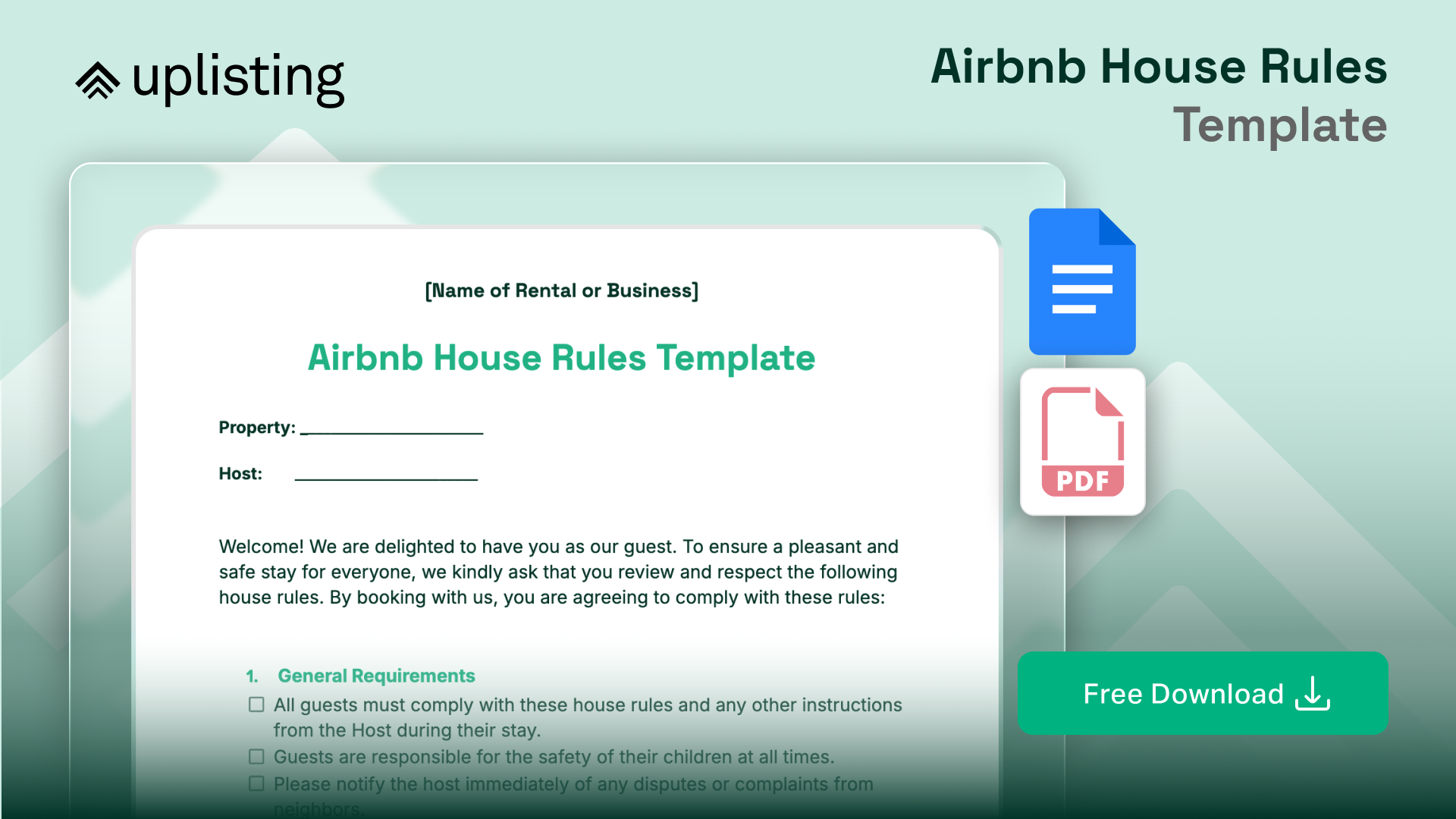
Set guest expectations, prevent disputes, and streamline your vacation rental operations.
Receive an easily editable google doc file or download it directly as a PDF.
Most short-term rental hosting problems don’t start with bad guests. They start with unclear expectations.
When rules are vague, buried in long messages, or explained differently every time, guests fill in the gaps themselves. That’s when small misunderstandings turn into neighbour complaints, damaged property, or late-night messages asking what should have been obvious from the start.
House rules aren’t about being strict or controlling. They’re about creating clarity. When guests know exactly what’s expected of them, they relax, enjoy the stay, and leave fewer surprises behind. Clear rules protect your space, your time, and your relationship with the people staying in your home.
That’s why a well-structured Airbnb house rules template matters. Instead of rewriting rules for every booking or listing, a template gives you a single, reliable framework you can customize once and reuse everywhere. It’s the simplest way to stay consistent, professional, and protected as your hosting business grows.
Many hosts see house rules as a formality, something added at the end of a listing and rarely revisited. In reality, house rules shape the entire guest experience long before check-in.
Good house rules set expectations rather than punish behavior. They explain how the space works, what guests should know, and where boundaries exist, all in a way that feels reasonable and transparent. When expectations are clear, guests are far more likely to follow them without friction.
Clear rules also reduce problems before they happen. Instead of reacting to noise complaints, extra guests, or improper checkouts, you prevent them by addressing these points upfront. Guests don’t push boundaries they understand.
There’s also a strong link between clear rules and better reviews. Guests feel more confident when nothing catches them off guard, and hosts feel less stressed when stays run smoothly. Everyone knows what success looks like.
Most importantly, house rules protect both sides. They give guests clarity and structure, and they give hosts something to reference when issues arise. When written clearly and shared consistently, house rules become one of the most powerful tools in a host’s toolkit, not a limitation, but a safeguard.
Cover all your bases, from noise and parking policies to smoking guidelines and amenity use. Customize the template once, and reuse it again and again.
Every Airbnb house rules template worth its salt covers the basics, with clear, practical ground rules that keep operations predictable and guest behavior in check.
The best templates spell out expectations from day one, so you spend less time fielding frantic questions or cleaning up messes. Our downloadable house rules template (below!) covers the full list in detail, so you never wonder what to add or how to phrase it.
You’ll find each rule in the downloadable template, ready to edit for your property.
Let's take a look at each one of those rules individually and flesh it out more. What should be included in the rules for this section, and why?
Quiet hours make or break neighbor relations. Standard quiet hours (like 10 p.m. to 8 a.m.) keep everyone happy and local authorities off your back.
If your property falls under a homeowners’ association or strict city ordinance, include those noise limits too. The template makes it easy to state exactly when guests need to tone it down, no drama required.
Maximum occupancy isn’t just a number, it’s your first line of defense against surprise sleepovers and insurance headaches.
Spell out how many guests can stay, and what happens if unregistered visitors show up. If you charge for extra guests, make those fees obvious in the rules. The template keeps things crystal clear so expectations are set long before anyone arrives.
Strict party bans aren’t about being the fun police, they keep your property in one piece and neighbors from calling in complaints.
State in plain English that parties and large gatherings aren’t allowed, and back it up with clear penalties. The template even includes sample language for charging fines or ending stays when rules are broken.
Let guests know up front if furry friends can come, or if pets are completely off the table. For properties that allow pets, explain deposits, leash policies, and which furniture is off-limits. Smoking is another hot button: ban it inside, or set a specific outdoor spot and spell out clean-up rules. The template covers both scenarios, so you don’t have to rewrite every time.
Precise check-in and check-out times help avoid awkward run-ins and cleaning chaos. If you offer late check-out, clarify when and how extra fees apply. Include reminders for guests to take out trash, wash dishes, and lock up—so your next turnover doesn’t start with surprises.
Ask for prompt reporting of any damage, no matter how small. If you offer a pool, hot tub, or shared spaces, include specific rules and disclaimers around safety and liability. The template’s ready-made language covers these details, making it easy to update for special amenities, so everyone knows where they stand.
House rules only work if guests actually read and follow them. Instead of long-winded explanations or flowery language, use clear, direct sentences. Short, specific statements leave nothing to interpretation and help guests know exactly what’s expected.
Consistency across every platform and message is key. Rules in your Airbnb listing should match what’s sent in confirmation emails and what’s posted on signs in the house. If one message says “no smoking” and another leaves it out, confusion, or disputes, are inevitable. Copying rules directly from your saved template ensures every guest sees identical information, no matter where they read it. That approach also cuts down on errors or last-minute edits.
Time is always in short supply, especially for hosts managing multiple properties. Scheduling rule reminders with automation tools ensures every guest receives the right message at the right time, before arrival, after check-in, or whenever a rule needs reinforcing. We wrote our template so that it integrates smoothly into automated communication, helping you spend less time on manual follow-up and more time running the business.

So, now you've got our download, it's time to put it in action. Here's how to use the template, step by step.
Start by personalising the template with your property name and your preferred contact details. This immediately ties the rules to a specific listing and makes it clear who guests should contact if they have questions. If you manage multiple properties, this step is what keeps everything clearly labelled and avoids confusion later.
Next, define the fundamentals. Confirm the maximum number of guests allowed, your check-in window, and your check-out time. These are the rules guests break most often when they’re unclear, so spelling them out simply and directly helps prevent awkward conversations and last-minute issues.
Adjust the template to reflect local regulations and the realities of your space. This might include quiet hours set by city ordinance, HOA requirements, parking restrictions, or safety rules for pools, hot tubs, or shared areas. The template gives you structure, but it’s flexible enough to reflect where and how you host.
Where rules need enforcement, add clear consequences. This could include fees for unregistered guests, smoking violations, or late check-outs. The key is clarity, not severity. When consequences are written down in advance, enforcement feels fair and professional rather than reactive.
Once your rules are complete, save a master version of the template. From there, you can duplicate it for each listing and make small tweaks where needed. One template becomes the foundation for all your properties, keeping your rules consistent and easy to manage as you scale.
One template, reused across every listing, means fewer mistakes, less rewriting, and far more confidence when issues arise.
House rules only work if guests actually see them. The most effective hosts share their rules consistently across every touchpoint.
Add your house rules directly to your Airbnb listing so guests see them before booking. This sets expectations early and filters out guests who aren’t a good fit. Send the rules again in pre-arrival messages, when guests are most likely to read them. This reinforces key points without feeling repetitive.
Include the rules in your welcome binder or digital guidebook so guests can reference them during their stay. This is especially helpful for longer bookings or shared spaces. Use in-property signage sparingly for critical reminders, like quiet hours or smoking policies, only where it genuinely helps.
The goal is consistency. When the same house ground rules appear everywhere in the same wording, guests are far more likely to follow them without question.
Even with clear rules, issues can happen. When they do, how you respond matters.
Start by calmly referencing the specific rule that applies. Pointing to a written agreement keeps the conversation factual and removes emotion from the exchange. Document what happened with photos, timestamps, and messages where appropriate. Clear records protect you if the situation escalates or a dispute arises later.
If a guest refuses to comply or the issue becomes serious, that’s when to involve Airbnb support or, in rare cases, local authorities. Having written house rules makes these steps much easier, because expectations were clearly communicated in advance.
Money disputes or damage claims often end up in the Airbnb Resolution Center. Submit documentation, photos, and a copy of your signed house rules template to support your case. The process is straightforward, and referencing your template is key to a smoother outcome. For a step-by-step walkthrough or advice on handling unexpected scenarios, the Airbnb Help Center has everything you need. Keeping communication professional and direct protects both your property and your reputation.
Clear rules don’t eliminate every problem, but they give you a framework to handle issues professionally, without stress or confrontation.
The easiest hosting problems to deal with are the ones that never happen. Clear house rules do that work quietly in the background. They set expectations before a guest arrives, remove guesswork during the stay, and give you something solid to lean on if questions or issues come up.
Using a reusable Airbnb house rules template turns what is usually a messy, reactive process into a system. You write your rules once, tailor them to your space, and reuse them confidently across every booking and every listing. No more rewriting, no more second-guessing, and far fewer uncomfortable conversations.
When those rules are paired with automation, the benefits multiply. Tools like Uplisting help you deliver house rules at the right moments, keep them consistent across platforms, and reduce the need for manual reminders. Guests receive the same clear guidance every time, and you get back the mental space that constant follow-ups used to take. When you’re ready to take your operations to the next level, Sign up for Uplisting here.
Hosting doesn’t have to feel tense or unpredictable. With the right rules and the right systems in place, it becomes calm, professional, and surprisingly simple.
Rules stay useful only when they match current law and how your property actually runs.
Plan to review your rules every year: pick a month, mark your calendar, and stick to it. If your city or county rolls out new short-term rental regulations, update your rules right away so your business stays compliant.
Using a ready-made template makes edits painless; just swap in the latest check-in times, pet policy, or quiet hours and send out the updated version before your next booking.
Rules outlined in your agreement usually hold weight as part of your contract with each guest. However, local laws decide what counts in a dispute.
The template includes a space for disclaimers and guest signatures to reinforce your agreement, but always double-check with someone who knows your local regulations. Stating house rules in clear language, like noise limits, pet restrictions, or smoking bans, helps you enforce expectations, but legal consequences depend on where your property sits.
For anything that could trigger eviction or fines, clear language in your rules (plus a quick review from a legal expert) gives you a stronger position.
No one wants to chase after rule-breakers, but sometimes guests ignore clear instructions. If that happens, document what went wrong with photos or messages.
Reference the exact rule from your template, don’t leave any room for debate. For smaller issues, a quick message usually solves the problem. For bigger breaches, like parties, safety concerns, or repeat offenses—contact Airbnb directly via the Resolution Center.
If a guest threatens safety or breaks the law, call local authorities and keep all records. Having your rules spelled out in every message, listing, and welcome binder makes enforcement far less stressful and gives you the backup you need if things escalate.

.png)