.svg)
Solutions
Features
Resources
.svg)
Trusted by 2,000+ operators
"Whether you have a smaller listing count or a larger one, Uplisting is easy to use, and it's scalable."
Josh Kristoff
Nomad Capital Adventures

4.8/5

4.9/5
Log in to your account
"Whether you have a smaller listing count or a larger one, Uplisting is easy to use, and it's scalable."
Josh Kristoff
Nomad Capital Adventures
Log in to your account

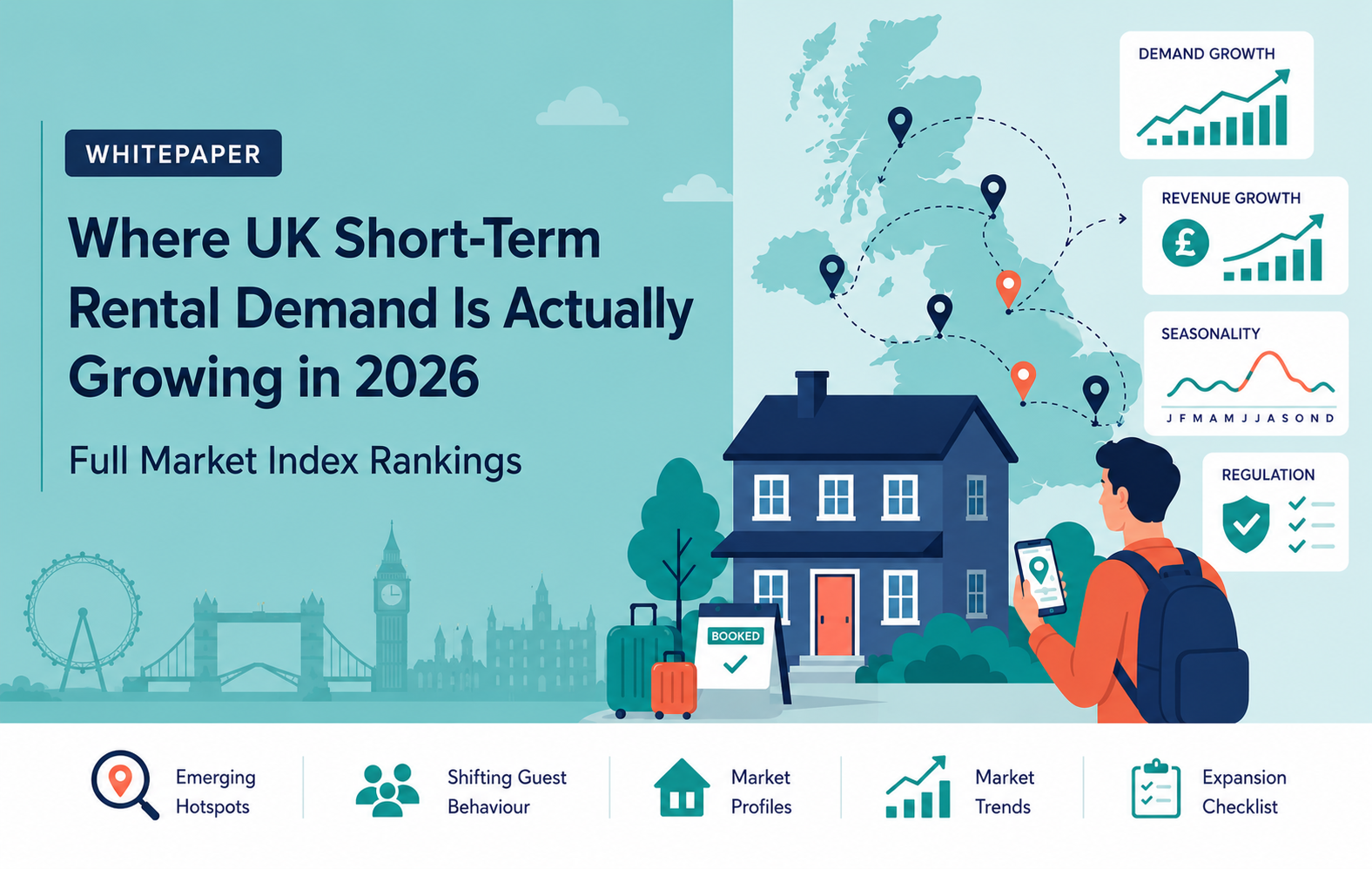
The emerging hotspots, the shifting guest behaviour, and what it means if you are running more than one property.
You already know the famous markets: Cornwall in August, Edinburgh during the Fringe. The trouble is everyone else knows them too, and by the time a market is on every “best places to invest” list, the easy money has usually gone.
This report is about the markets that are not on those lists yet. Using AirDNA data across 52 UK regions, we have ranked where short-term rental demand is genuinely growing in 2026, not just where occupancy already happens to be high. The two are not the same thing, and the difference matters more than most operators realise.
High occupancy tells you a market is busy now. Growing demand tells you where you can still get in before competition catches up. If you are deciding where to add your next property, the second question is the one worth answering.
The data shows:
A growing market with room to spare usually beats a saturated one with great headline numbers. Find where demand is rising before everyone else does, and you give yourself pricing power and a head start.
Occupancy is the metric the industry reaches for first. It is easy to understand and easy to quote. But on its own it can point you in the wrong direction.
A market running at consistently high occupancy looks like a winner, but often it can be a warning sign.
High, stable occupancy tends to mean a mature, crowded market where supply has caught up with demand and there is little room left to grow. You can buy into it, but you are buying at the top, competing hard for the same guests as everyone else, with limited scope to push rates.
Demand growth points the other way. When demand is rising, it often signals an opportunity. More visitors, better transport links and/or a shift in how and when people travel. These are the conditions that reward operators who act early.
Rising demand flags the markets where supply has not yet caught up. This gap is where the opportunity lives:
As the UK sector matures, the operators pulling ahead are the ones reading these underlying signals, not just headline occupancy figures.
Growing markets tend to offer better long-term returns than saturated ones. Spotting where demand is rising helps you expand before the competition arrives and the margins tighten.
We wanted a score that reflects real opportunity. So the Index combines four factors that each tell you something different about a market. Together they give a full picture of market opportunity.
How often properties get booked across the year, using a mix of annual occupancy and listing growth. It is a read on raw travel demand in the area.
A higher score means stronger travel demand.
Whether listings earned more this month than they did in the same month last year, based on the year-on-year change in RevPAR for properties booked in both periods.
A higher score means rising revenue per property.
How far demand swings between peak and quiet months, measured as the percentage gap between the lowest and highest monthly average revenue over the past year.
A higher score means lower seasonality, so steadier income across the year.
Whether you can run a short-term rental here without running into legal trouble, based on host and property signals that point to regulation and enforcement.
Higher score means lighter or less-enforced regulation.
Each factor feeds the overall Market Index Score. Individual metrics show you where a market is strong; the combined score shows you where performance is balanced enough to be worth building on.
Scores run from 40 to 100, with 100 being the strongest. The top five are highlighted; with profiles for each of them below.
The UK’s strongest STR markets are represented by a range of different places, but they share some common ground: growing visitor demand, solid revenue performance, and consistent booking activity throughout the year.
Take a look at what drives the top 5 UK STR markets in 2026:
Top of the table, and it earned the spot by being good at everything, rather than spectacular at one thing. Demand is strong, revenue growth is healthy, and seasonality is moderate by the standards of a leisure market. No single weak point drags it down.
The pull here is countryside. Rural escapes, walking and the outdoors, heritage, and a steady stream of domestic short breaks keep bookings ticking over through the year.
For operators, that balance is the appeal: dependable demand and revenue without the violent peaks and troughs of a pure holiday market. If you want sustainable growth over seasonal fireworks, this is a market built for it.
Chester’s strength is demand that shows up all year. High rental demand paired with low seasonality means a longer trading period and fewer dead weeks. Revenue growth is more modest than some of its neighbours on the list, but the sheer steadiness more than makes up for it.
As an established destination, Chester draws a healthy mix: leisure visitors, heritage tourism, retail, and regional business travel, all helped by good transport links. For anyone running several properties and tired of the feast-or-famine cycle, that predictability is worth a lot.
This is the earnings play. Gloucester and Cheltenham pair strong demand with one of the highest revenue growth scores in the top tier, which means operators are not just filling calendars, they are earning more per booking than they were a year ago.
Seasonality runs a little higher than the others, but the growth more than offsets it. A broad mix of leisure visitors, event-goers and business travellers keeps demand spread across segments. If your priority is revenue potential rather than pure stability, this may be the most attractive market on the whole list.
The steadiest market in the study. St. Albans and Buckingham posts one of the highest seasonality scores anywhere in the data, which means demand barely moves between peak and off-peak. Its demand and revenue growth scores sit below the other leaders, but that consistency carries it into the top five on its own.
Proximity to major employment centres, strong transport links, and a blend of leisure and business demand keep bookings flowing year-round. If you value predictability, this is about as close as the UK gets. Flat demand makes forecasting, staffing and turnaround planning far simpler, which matters more with every property you add.
Cambridge is the all-rounder, strong on demand and seasonality alike, with no real weakness across the four factors. It draws guests right through the year, which props up both occupancy and operational stability.
The demand base is unusually diverse: academia, tourism, business travel and a busy events calendar, so no single segment makes or breaks the year. For established operators and newer investors alike, that mix of strong demand and low seasonality is a solid foundation to grow on.
Demand growth is the clearest single signal of where opportunity is heading. Look at the top of this list and a pattern jumps out: these are not one-trick markets.
Most are well-known destinations, but their demand is propped up by more than tourism alone. Business travel, major events, universities and cultural pull all feed in, and that breadth keeps demand growing beyond the obvious peak weeks.
Edinburgh, Bristol and Oxford show the strength of cities that blend leisure and professional travel. Highland and Stirling show that domestic, experience-led travel is still very much alive.
There is a behavioural shift underneath all this too. Travellers keep gravitating towards places that combine easy access, genuine local experiences and flexible accommodation. With hybrid working still common, longer stays and midweek bookings are spreading demand across more of the calendar and more of the map. For operators, fast-growing demand marks the areas where the window is still open, before competition closes it.
Strong demand growth points to markets with varied travel drivers (tourism, business, events, education). These are often the emerging openings where you can establish yourself before the market fills up.
Demand gets people through the door. Revenue growth tells you how well that market turns footfall into money…and the names at the top here tell a clear story.
Several are established leisure destinations where strong demand is handing operators real pricing power, a combination of healthy occupancy and rising daily rates. The run of Welsh coastal and rural markets, Gwynedd, Anglesey and Conwy, is striking. It suggests guests are still happy to pay a premium for experience-led travel and quality accommodation in sought-after spots.
Rising revenue is attractive because it usually signals improving profitability, not just busier calendars.
The caveat: it tends to hold only where demand stays strong, rather than where operators are simply pushing rates and hoping. The markets that show both rising demand and rising revenue are the ones worth taking most seriously.
Revenue growth shows how well demand converts into income, usually through a mix of occupancy and pricing power in established leisure markets. The markets rising on both demand and revenue offer the strongest long-term case.
Growth gets the attention, but for a lot of operators consistency is worth just as much. A market that earns steadily for twelve months is often easier to run, and easier to plan around, than one that makes its whole year in a frantic summer.
The top markets here are mostly cities with mixed demand. Business travel, universities, events and year-round economic activity smooth out the booking calendar.
For you, lower seasonality means more predictable occupancy, cleaner revenue forecasting and far simpler operational planning. When you are juggling several properties, multiple cleaning teams and a string of suppliers, that predictability is a genuine operational advantage, not just a nice-to-have.
Birmingham, Manchester and Leeds near the top is no accident. Markets with several independent demand drivers are better placed to keep occupancy up when the traditionally quiet weeks arrive. If you are building a portfolio for the long haul, year-round resilience deserves as much weight as headline growth.
Steady, low-seasonality markets, usually larger cities with diverse demand, give you more predictable occupancy across the year. That stability supports stronger operations and a more resilient portfolio.
Most of the UK remains lightly regulated for short-term rentals, but there are two areas worth noting. Wales has brought in planning controls and new rules for holiday lets, whilst London still enforces its 90-night annual cap on entire-home lets without planning permission.
If you are weighing up a new market for 2026, treat regulation as a fourth dimension alongside demand, revenue and seasonality. Most markets are still open for business, but checking local requirements before you commit saves you from nasty surprises later, whether that is unexpected costs, restrictions or a compliance headache you did not budget for.
Learn more in our UK Short-Term Rental Regulation in 2026 guide.
Most UK markets are lightly regulated, but Wales and London are stricter. Weigh regulation alongside demand and revenue before you expand into a new area.
Plenty of the top performers sit well outside London’s tourism orbit. Regional cities, rural areas and smaller visitor markets are pulling in more guests every year.
Markets that blend leisure, business, education and events behave far more steadily than places leaning on a single source of demand.
Some of the strongest revenue growth is happening in coastal and rural markets, a sign that travellers will still pay a premium for the right location and a genuine experience.
Low-seasonality markets show up again and again near the top. As operators get more serious about sustainable growth, steady year-round performance is becoming a headline measure of how good a market really is.
The rankings keep pointing to markets that combine solid demand, manageable competition and good operating conditions, rather than simply the biggest or busiest names. That is where the room to grow tends to be.
Three properties used to feel manageable. Then you added the fourth, in a new city, with a new cleaning team and a calendar that never quite syncs with the others. Suddenly the thing eating your week is not finding bookings, it’s keeping on top of the ones you already have.
Growth creates opportunity, but it also creates complexity. As your portfolio expands, the volume of guest messages, bookings and day-to-day coordination climbs fast, and it climbs across multiple properties at once. The usual pressure points show up in the same places:
None of these are dramatic on their own. They just multiply, quietly, until admin is the thing setting the ceiling on how much you can grow.
The operators best placed to ride growing demand are usually the ones whose systems can handle scale without everything routing through them personally. As the portfolio grows, consistency becomes the thing that protects you.
Streamlined guest messaging, reliable scheduling and accurate reporting let you maintain service quality while reducing admin. Get the foundations right and they do more than support growth. They support guest satisfaction, take pressure off your team and protect your margins as you scale.
A new market can be a great move, but not every market is right for every operator. Before you commit, it is worth asking yourself the following questions to ensure you’re ready to take on more.
Before adding properties, make sure you have solid processes for:
The UK short-term rental market still has plenty of room for operators willing to look past occupancy alone. Sure, occupancy matters, but the strongest opportunities in 2026 sit in markets that pair growing demand with healthy revenue growth and year-round resilience.
And the data shows, a lot of these markets sit well outside the biggest and best-known destinations.
Picking the right market is only half the job. The other half is having the systems to handle the complexity that comes with adding more properties. Get both right and you are in a far stronger position to make the most of where demand is heading through 2026 and beyond.
Connect every channel, automate the day-to-day, and keep your listings compliant, all from one platform. When you are ready to add that next property, the operational side is already handled.

.png)