.svg)
Solutions
Features
Resources
.svg)
Trusted by 2,000+ operators
"Whether you have a smaller listing count or a larger one, Uplisting is easy to use, and it's scalable."
Josh Kristoff
Nomad Capital Adventures

4.8/5

4.9/5
Log in to your account
"Whether you have a smaller listing count or a larger one, Uplisting is easy to use, and it's scalable."
Josh Kristoff
Nomad Capital Adventures
Log in to your account

Registration schemes. Licensing deadlines. Safety obligations. Tax changes.
A practical guide for UK short-term rental owners, operators, and property managers.
Short-term rental regulation in the UK is changing quickly. Across all four nations, new rules are being introduced around registration, licensing, safety, and tax, and operators need to keep up.
England is introducing a national registration scheme this year. Scotland already requires mandatory licensing, with penalties for non-compliance. Wales will launch its visitor accommodation register in October 2026. In Northern Ireland, all short-term rentals must be certified by Tourism NI.
This guide breaks down what these changes mean in practice. It covers the key requirements across each region, the impact on your operations, and where issues commonly arise.
Most importantly, it shows how to stay compliant without adding unnecessary complexity to your day-to-day.
England registration scheme: imminent (2026) | Wales register opens: October 2026 | Scotland: mandatory since January 2025 | Northern Ireland: Tourism NI cert now required
Short-term rentals now represent a significant part of the UK accommodation market, and that scale is driving increased regulation.
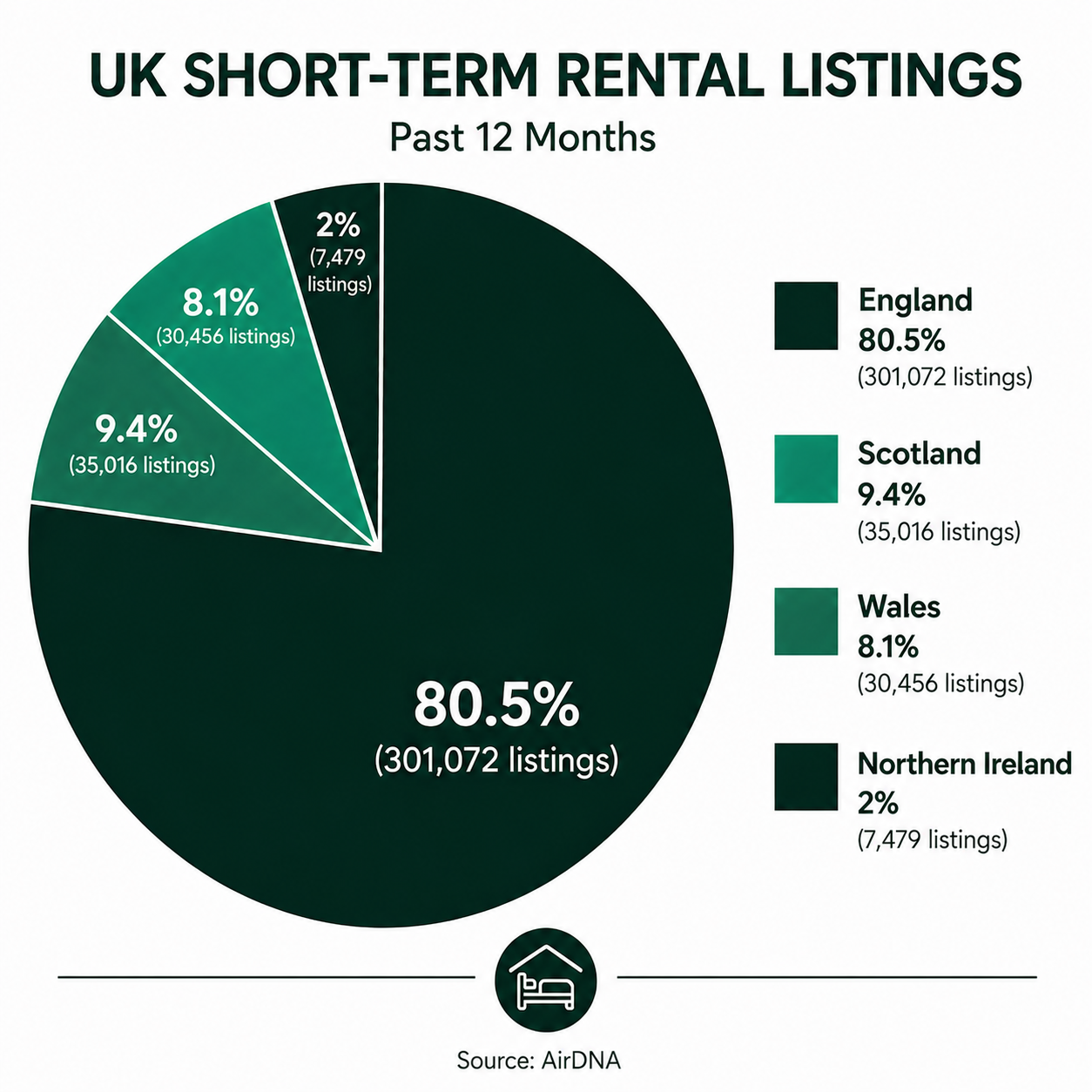
AirDNA data shows that in the past 12 months, there were over 374,000 available listings across the UK, a 2.8% increase on the 12 months. Of these available listings, 80.5% were in England, 9.4% in Scotland, 8.1% in Wales and 2% in Northern Ireland.
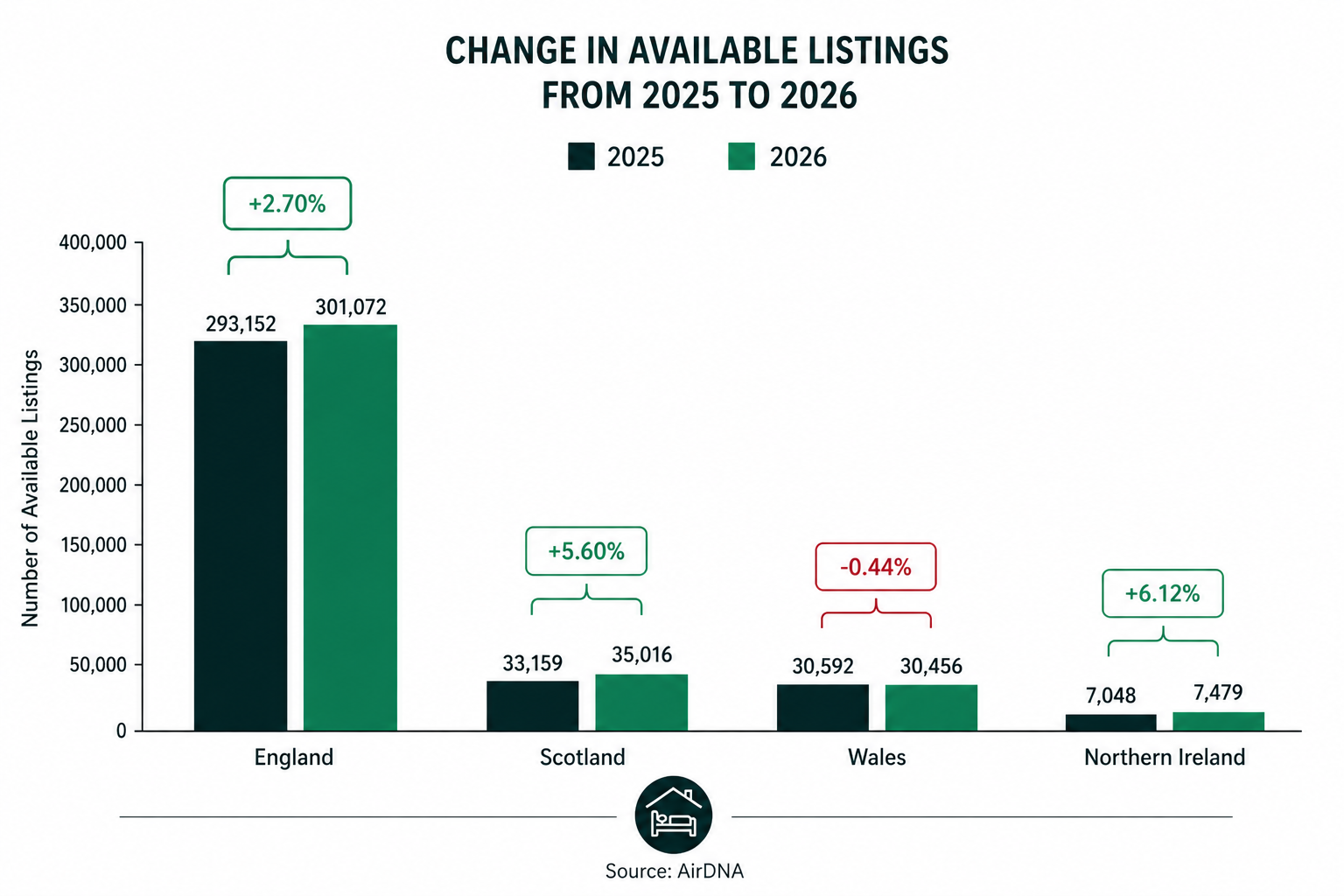
The number of available listings continues to grow in most countries in the UK with the exception of Wales. Potentially impacted by the increased legislative pressures from the Senedd Cymru.
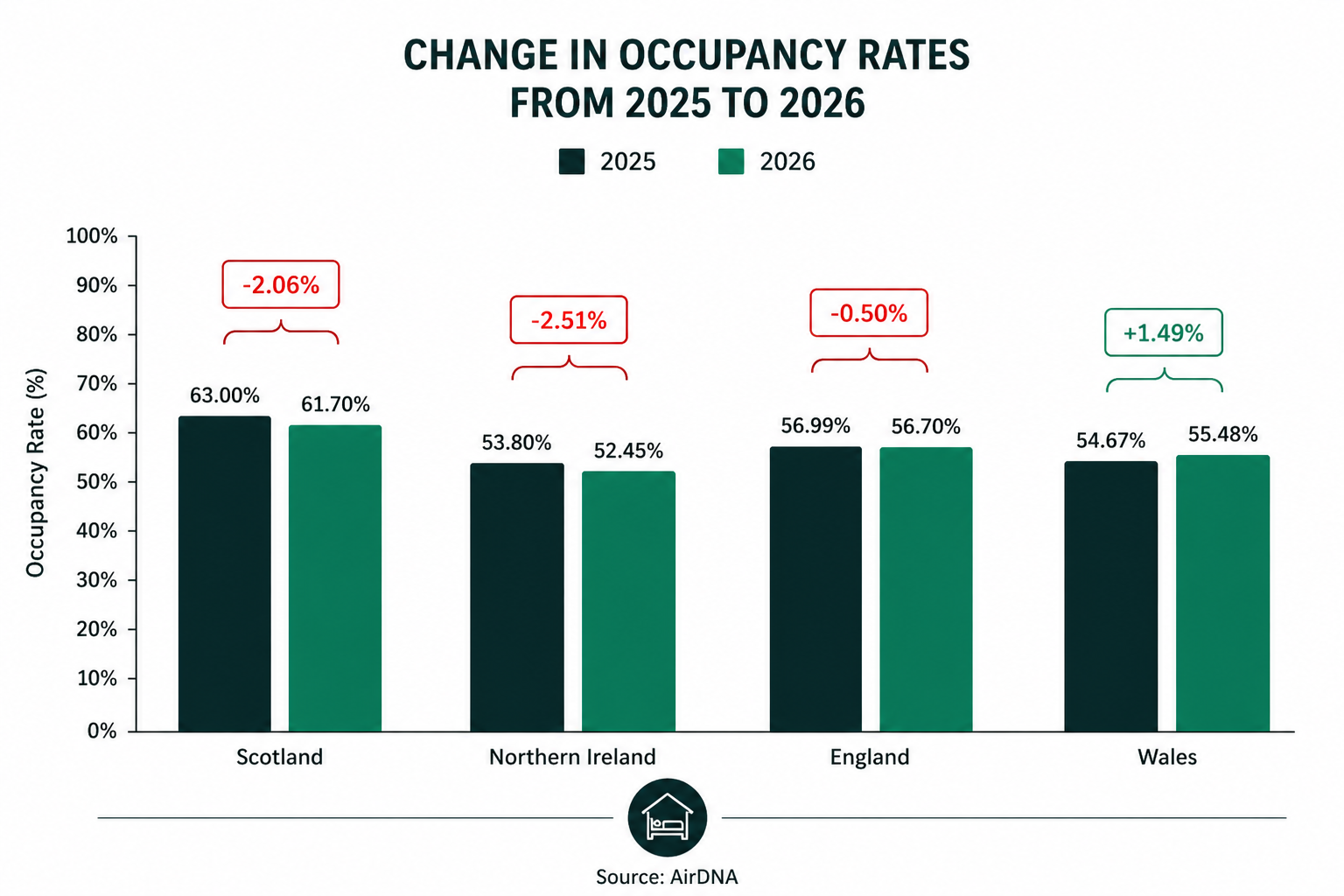
However, surprisingly, Wales is the only country seeing a marked increase in Occupancy Rates versus other UK countries across all sub-markets.
With an average average daily rate (ADR) increase in the UK of 5.42%, Revenue continues to increase across all countries. Scotland is the standout winner in terms of revenue increases, albeit below England's expectedly higher Total Revenue. Wales has the highest ADR increase of 8.95% from 2025 to 2026, but an overall revenue increase of 2.53%.

These figures show precisely why governments are paying attention.
Just 3 submarkets out of 52 accounted for over 25% of available listings, and 12 submarkets accounted for over 50%.
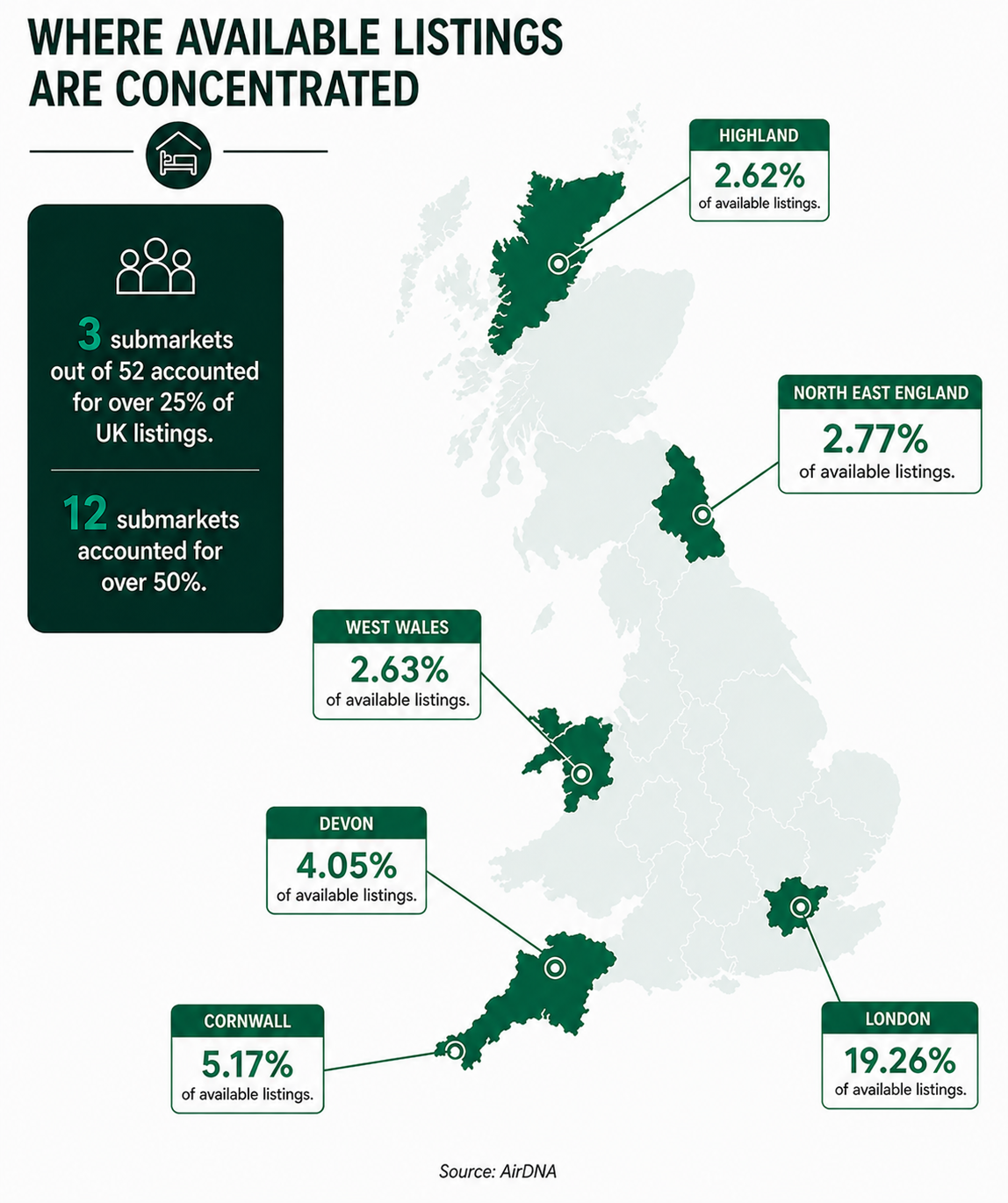
This level of concentration is a key driver of local regulation. Areas with the highest volume of stays are more likely to introduce stricter licensing rules and enforcement, making them important to monitor if you operate at scale.
Most compliance failures are not the result of ignorance. They're the result of systems that don't scale.
Tracking a handful of properties in a spreadsheet can work early on. As your portfolio grows, it becomes harder to stay on top of requirements, deadlines, and limits across multiple listings and platforms.
These are some of the most common ways operators run into problems.
Airbnb automatically blocks bookings once a property reaches the 90-night limit in London, but it only tracks bookings made through Airbnb.
If you’re also listing on Booking.com, Vrbo, or taking direct bookings, those nights aren’t counted. That means it’s possible to exceed the cap without realising.
Westminster Council alone investigated 2,400 potential breaches in a single year, with fines of up to £20,000 per offence.
Without a single view of bookings across all channels, it’s easy to go over the 90-night limit. For operators using multiple platforms, tracking total nights isn’t optional, it’s essential.
Since April 2023, it is not enough for a property to be available for booking. It must be actually let for at least 70 nights per year to remain eligible for business rates treatment.
The Valuation Office Agency reviews letting records, booking evidence, and financial data such as bank receipts. In 2023/24 alone, 11,960 properties were removed from the business rates list.
For operators with a rateable value at or below £12,000, losing business rates status can also mean losing Small Business Rates Relief. In some cases, it may also trigger a council tax charge, including a second home premium.
To maintain business rates eligibility, ensure each property is actively let for at least 70 nights per year and that records clearly evidence this.
Standard home insurance does not cover short-term letting. Most policies void the moment you accept paying guests.
The right cover for an STR property typically needs to include:
In Scotland, public liability and buildings insurance are mandatory licensing requirements. In England and Wales, they are not explicitly required for short-term lets, but operating without cover exposes owners to potentially unlimited personal liability.
A single serious guest injury claim can exceed the value of the property if adequate insurance is not in place.
Standard home insurance often excludes short-term letting, and some operators only discover this when a claim is rejected. Always review policy wording carefully, not just renewal dates.
If a property is leasehold, short-term letting may be restricted or prohibited entirely by the lease, regardless of what planning rules allow.
Many residential leases include clauses that prevent subletting without consent, limit use to a private dwelling, or prohibit lettings under six or twelve months.
Breaching a leasehold covenant can lead to enforcement action, including forfeiture proceedings, which in the most serious cases can result in loss of the lease. It may also expose leaseholders to injunctions or claims for damages from the freeholder or other leaseholders.
Before listing a leasehold property, the full lease should be reviewed carefully, and legal advice sought where any clauses are unclear.
Short-term letting a leasehold property with subletting restrictions is one of the most common legal exposures in the sector. The fact that Airbnb accepted your listing is not evidence that your lease permits it.
A fire risk assessment is not a one-off requirement. It must be reviewed annually, and updated whenever there are changes to the property, such as new furniture, layout adjustments, or additional appliances.
Since early 2025, platforms including Airbnb, Booking.com, and Vrbo have required fire safety documentation to be uploaded before listings go live. However, uploading a document once does not ensure ongoing compliance if the assessment itself becomes outdated.
In some cases, operators inherit properties where fire risk assessments already exist and continue to rely on them without re-commissioning or reviewing them. If an incident occurs and the assessment is not current, the responsible person may face significant penalties, including unlimited fines and potential criminal prosecution.
Update your fire risk assessment after any changes to your property, including layout alterations or new appliances. Don’t assume it will stay current, you could face unlimited fines or even criminal prosecution.
Residential mortgages typically prohibit commercial letting activity.
Short-term letting on a residential mortgage without consent from your lender is a breach of your mortgage terms, which can trigger a demand for immediate repayment.
Some lenders offer specialist holiday let mortgage products, typically at higher rates. Others may grant consent to let on a case-by-case basis depending on individual circumstances.
These requirements must be confirmed before any bookings are taken, rather than identified during refinancing or a later stage of ownership.
Make sure your mortgage allows short term lets before your first booking. Failure to do so could result in the demand for immediate repayment of your mortgage.
Use this as a practical reference to reduce common compliance gaps across your portfolio:
Compliance risk is rarely caused by a single issue. It usually comes from small gaps across multiple areas. A structured system is the most reliable way to stay ahead.
The legal foundation for England's national Short-Term Let Registration Scheme was established in the Levelling-up and Regeneration Act 2023.
The statutory definition: a short-term let is a dwelling or part of a dwelling provided for use by a guest as accommodation (other than the guest's only or principal residence), in return for payment and in the course of a trade or business.
A public consultation ran from June to September 2023. 61% of respondents supported mandatory registration. The government confirmed a mandatory national scheme in February 2024. Tourism Minister Sir Chris Bryant stated in July 2025 that the register would go live by April 2026, initially voluntary before becoming mandatory. A private beta launched in October 2025, testing with 200 to 400 participants.

As of April 2026, the scheme has not fully launched. Legal commentary from firms including Keystone Law and Chambers and Partners has noted uncertainty around the timeline, and the GOV.UK policy page has not been updated since February 2024, while the system remains in beta testing.
Despite delays, the direction of travel is clear. Operators who wait for formal launch announcements before preparing documentation are likely to face operational delays once the scheme goes live.
When it launches, each registered property will receive a unique registration number for display on all platform listings. Platforms are expected to restrict listings to registered properties only. Hosts will need to provide property addresses, occupancy data, safety certificates (fire, gas, electrical), and planning permission status.
Gather all safety certificates. Document your letting history. Ensure every property's paperwork is current. When the portal opens, organised operators will register first and keep their listings live.
Alongside the registration scheme, the government has consulted on introducing a new planning use class (C5) for short-term lets. This would allow local authorities to control the conversion of residential properties into short-term accommodation, including through Article 4 directions.
An alternative designation (C7) has also been discussed in the House of Lords as part of the Renters’ Rights Bill.
As of early 2026, neither C5 nor C7 has been added to the Use Classes Order. However, both proposals reflect a clear policy direction towards greater local planning control over short-term lets.
Scotland operates the UK's most established STR regulatory framework.
The Civic Government (Scotland) Act 1982 (Licensing of Short-term Lets) Order 2022 came into force on 1 March 2022. The full compliance deadline passed on 1 January 2025.
Every STR property in Scotland must now hold a licence; operating without one is a criminal offence.
The scheme recognises four licence types:
Secondary letting accounts for 79% of all licences and faces the heaviest scrutiny, particularly in designated control areas.
Operators must submit:
Each application is reviewed by Police Scotland, Scottish Fire and Rescue, and the council's planning, environmental health, and building standards teams. A fit-and-proper-person test applies to all applicants.
By 31 December 2024, 31,416 validated applications had been received and 25,869 licences granted. Highland, Edinburgh, and Fife account for 45% of all applications.
Fees vary significantly by council. In Edinburgh, secondary letting fees range from £653 to £5,869 per year depending on capacity. Edinburgh grants secondary letting licences for just one year, while most other councils allow three.
A professional operator with ten Edinburgh properties at 4 to 5 occupancy faces approximately £10,890 annually in licensing fees alone, before safety certificates and insurance.
Operating without a licence carries fines of up to £2,500 and a potential one-year ban on applying. All advertising must display the licence number.
Edinburgh introduces Scotland's first visitor levy (a 5% charge on accommodation costs) from 24 July 2026, expected to raise up to £50 million annually. Glasgow plans a similar levy from January 2027.
Edinburgh became Scotland's first control area in September 2022. Any change of use from dwelling to secondary letting automatically requires planning permission. Highland Council agreed in February 2026 to consult on five additional areas.
Wales has built the most layered STR regulatory framework in the UK, combining new planning use classes, a mandatory national register, a visitor levy, and a forthcoming licensing scheme. Each layer has different timelines, and different penalties for missing them.
The Town and Country Planning (Use Classes) (Amendment) (Wales) Order 2022 created three distinct residential categories:
Local authorities can issue Article 4 directions requiring planning permission for changes between these classes.
Eryri (Snowdonia) National Park's direction took effect on 1 June 2025.
The Visitor Accommodation (Register and Levy) Etc. (Wales) Act 2025 received Royal Assent on 18 September 2025. Registration opens 1 October 2026, administered by the Welsh Revenue Authority.
It covers anyone charging visitors for overnight stays of 31 nights or less.
Registration is free and designed to take under 15 minutes.
The penalty for non-registration is £100 per premises.
The Act also empowers local councils to introduce a visitor levy from 1 April 2027 at the earliest. The rate is set at £1.25 to £1.30 per person per night for standard accommodation and £0.75 for hostels and campsites.

Revenue is ringfenced for local tourism investment. No council has formally introduced the levy yet.
Since April 2023, self-catering properties in Wales must be available for 252 days and actually let for 182 days per year to qualify for business rates.
Properties failing the test revert to council tax, potentially including second home premiums of up to 300%.
Industry surveys suggest roughly 40% of Welsh holiday lets have struggled to meet the 182-day requirement.
The threshold is the highest in the UK, and it catches operators who let their properties seasonally or take extended breaks from hosting. From April 2026, averaging across multiple years is permitted, which provides some relief for properties with variable seasonal demand.
After the Furnished Holiday Lettings (FHL) tax changes in 2025, many Welsh holiday let owners reduced their availability. This jeopardised their business rate status.
A separate licensing bill for visitor accommodation passed the Senedd in March 2026, starting with self-contained self-catering properties. It will require gas and electrical safety certificates, CO alarms, public liability insurance, and fire safety risk assessments. The licensing scheme is expected to commence around 2029.
Under the Tourism (Northern Ireland) Order 1992, all tourist accommodation operated in the course of a trade or business must hold a certificate issued by Tourism NI. This includes self-catering properties, B&Bs, guest houses, hotels, hostels, and short-term lets such as Airbnb listings.
Unlike England, there is no minimum threshold. A single paid booking is sufficient for a property to fall within scope.
The certification process involves an application (fee of £40 per unit, maximum £350), inspection by a Tourism NI assessor, and issuance of a certificate valid for four years.
Certified properties must meet minimum standards relating to safety, cleanliness, maintenance, and facilities. Operators are also required to maintain a visitor register and display their certificate in a visible location.
Operating without certification is a criminal offence, with penalties of up to £2,500 in fines, six months’ imprisonment, or both.
The Department for the Economy ran a consultation between October 2025 and January 2026 on updating these standards, which have remained largely unchanged since 2011.
Many Airbnb-style operators in Northern Ireland are unaware they need Tourism NI certification. The platform will accept your listing; the law does not care. Verify your certification status now.
Standard home insurance does not cover short-term letting. Most policies explicitly void cover once paying guests are present.
A purpose-built STR policy should include:
In Scotland, public liability and buildings insurance are mandatory licence conditions with documentation submitted at application.
In England, Wales, and Northern Ireland, STR-specific insurance is not legally mandated, but the exposure without it is significant. A claim arising from a guest injury, flood damage caused by a guest, or theft can run to six figures. Without the right policy, that sits with you personally.
Specialist providers include Schofields, Pikl, Guardhog, and SuperCover. Premiums vary based on property type, occupancy level, and location. Expect to pay significantly more than a standard landlord policy, but a fraction of what an uninsured claim would cost.
If your STR property is leasehold, check the lease before you list, not after.
Many residential leases contain clauses preventing subletting without consent, restricting use to a private dwelling, or prohibiting short-term lets explicitly. Breaching a leasehold covenant exposes you to injunctions, damages, and in serious cases forfeiture proceedings.
The fact that a platform accepted your listing, or that a local planning authority has no objection, does not override private contractual obligations in a lease. Leasehold restrictions are enforced by freeholders and residents' management companies, not by planning authorities.
If the subletting clause in your lease is ambiguous, get legal advice before you accept your first booking.
Safety obligations apply across all four nations and are increasingly verified by platforms before listings go live. The certificates below are not optional extras, several carry criminal penalties for non-compliance, and gaps in documentation can void your insurance and your listing simultaneously.
Since 1 October 2023, the Building Safety Act 2022 requires written fire risk assessments for all paying-guest accommodation. The responsible person must identify fire hazards, install interlinked smoke and heat alarms, maintain clear escape routes, provide fire extinguishers and fire blankets, and review the assessment annually and after any property changes.
Since early 2025, Airbnb, Booking.com, and Vrbo require uploaded fire safety documentation before listing.
Gas safety certificates are required annually under the Gas Safety (Installation and Use) Regulations 1998 for any property with gas appliances. A Gas Safe registered engineer must inspect all gas pipes, flues, and appliances and issue a CP12 certificate.
Records must be kept for at least two years and displayed in the property for lets under 28 days.
Holiday lets sit in a grey area under the Electrical Safety Standards in the Private Rented Sector (England) Regulations 2020, which technically apply only to tenanted properties. However, the Electricity at Work Regulations 1989 impose a general duty to maintain safe installations, and the fire risk assessment process requires EICR evidence in practice. Scotland mandates EICRs for all licensed STLs.
Every professional operator should obtain an EICR every five years, insurers typically require one, and claims may be rejected without it.
The Smoke and Carbon Monoxide Alarm (Amendment) Regulations 2022 require at least one smoke alarm on every storey with living accommodation and a CO alarm in any room containing a fixed combustion appliance (excluding gas cookers in England). For holiday lets, the Fire Safety Order guidance goes further, interlinked smoke and heat alarms throughout, mains-powered where practicable.
Test at every guest changeover.
For holiday lets where guests are responsible for energy costs and the property is let for four or more months annually, an EPC is required (minimum rating E). Where the owner pays energy costs (standard for most holiday lets), the legal position is less clear, though Scotland requires EPCs regardless.
From 1 October 2030, all private rental properties in England must reach at least EPC band C (£10,000 cost cap per property). Whether this will apply specifically to holiday lets awaits final legislation.
The April 2023 rule change ended the practice of qualifying for business rates by advertising availability alone.
The new criteria require all three conditions simultaneously:
Private nights and discounted stays for friends and family do not count toward the 70-night threshold.
The Valuation Office Agency verifies compliance using letting records, booking evidence, and rental income receipts. 11,960 self-catering holiday homes were removed from the business rates list in 2023/24; 21% of all property deletions from the non-domestic rating list that year.
For properties that do qualify, Small Business Rates Relief remains valuable: properties with a rateable value at or below £12,000 pay zero business rates. Many rural and coastal lets fall within that band.
The abolition of the Furnished Holiday Lettings tax regime from April 2025 removed four advantages operators had relied on:
These changes apply regardless of business rates status.
Operators who have not reviewed their tax position with an accountant since April 2025 should do so. The implications are clear: without a recent review, you risk higher income tax, poor CGT outcomes on disposals, and missed pension opportunities.
HMO licensing generally does not apply to short-term lets because the Housing Act 2004 requires occupants to use the property as their only or main residence; a condition holiday guests do not meet.
Mandatory licensing triggers when five or more people from two or more separate households share facilities.
The risk is for operators who let rooms individually to unrelated occupants who treat the property as their main home. For example, workers on long-term placements.
In those cases, HMO classification may apply regardless of how the letting is marketed. Penalties include unlimited fines and rent repayment orders covering up to 12 months of income.
Outside London there is no fixed night cap. Planning authorities apply a case-by-case material change of use test, weighing frequency and duration of lettings, neighbourhood impact, and whether the property operates more like a hotel than a home.
A property let commercially year-round with high guest turnover may well constitute a change from C3 (dwellinghouse) to C1 (hotel) or sui generis use.
From April 2025, councils in England can charge up to 100% council tax premiums on second homes.
Operators who manage compliance effectively are not spending more time on it. They have built systems that reduce manual effort and create structured processes.
The right software stack turns recurring administrative tasks into automated reminders, centralised dashboards, and audit-ready records.
A property management system (PMS) consolidates bookings across all channels into a single calendar. This is not just operationally efficient,for London-based operators, it is the only reliable way to track cumulative nights across platforms against the 90-night cap.
More broadly, it provides the booking history, occupancy data, and financial records required for business rates assessments and emerging registration schemes.
Platforms such as Uplisting connect listings across Airbnb, Booking.com, Vrbo, and direct bookings, with unified calendars, automated messaging, and financial reporting built in.
Compliance management requires either dedicated tooling or a highly disciplined manual process.
Key features to look for include:
Missing renewal deadlines can invalidate insurance. Lapsed inspections can undermine safety compliance. These are not edge cases, they are recurring risks in scaling portfolios.
Guest ID verification has become operationally standard. Platforms supporting biometric ID checks, fraud scoring, and damage guarantee schemes reduce risk at the point of booking rather than after an incident.
Uplisting provides identity verification supporting 4,000+ document types from 100+ countries.
A missed gas safety renewal invalidates your insurance.
An exceeded London night cap is a planning breach.
A missed registration deadline takes your listing down.
The annual cost of a well-configured software stack is, in most cases, less than the cost of a single compliance failure.
Regulation across all four UK nations is moving in a consistent direction: mandatory registration or licensing, verified safety documentation, tighter planning controls in high-demand areas, and the introduction of tourism levies.
Scotland's licensing scheme, with over 31,000 applications processed and criminal penalties for non-compliance, is the clearest signal of where England, Wales, and Northern Ireland are heading.
Three things need your attention now:
The operators best placed for this environment treat compliance as infrastructure: systematised, automated, and reviewed regularly.
The tools to manage it efficiently already exist.
Connect all your channels, automate your operations, and keep your listings compliant, all from a single platform.
GOV.UK: Delivering a registration scheme for short-term lets (gov.uk/guidance/delivering-a-registration-scheme-for-short-term-lets)
AirDNA (https://www.airdna.co/)
Scottish Government: Short-Term Lets Licensing Statistics Scotland to 31 December 2024 (gov.scot)
Scottish Government: Short term lets, licensing scheme guidance for hosts and operators (gov.scot)
GOV.WALES: Registering visitor accommodation overview (gov.wales/registering-visitor-accommodation-overview)
GOV.WALES: Visitor levy to support tourism becomes law (gov.wales)
Tourism NI: Offering Tourist Accommodation in Northern Ireland (tourismni.com)
GOV.UK: Abolition of the furnished holiday lettings tax regime (gov.uk)
GOV.UK: Apply for business rates for a self-catering property in England (gov.uk)
GOV.UK: Smoke and Carbon Monoxide Alarm (Amendment) Regulations 2022 guidance (gov.uk)
Keystone Law: The proposed Short Term Rental Registration Register and a new use class for the short term rental sector (keystonelaw.com)

.png)