.svg)
Solutions
Features
Resources
.svg)
Trusted by 2,000+ operators
"Whether you have a smaller listing count or a larger one, Uplisting is easy to use, and it's scalable."
Josh Kristoff
Nomad Capital Adventures

4.8/5

4.9/5
Log in to your account
"Whether you have a smaller listing count or a larger one, Uplisting is easy to use, and it's scalable."
Josh Kristoff
Nomad Capital Adventures
Log in to your account


An IntelliHost + Uplisting Analysis | May 2026
For anyone running an Airbnb listing in 2026, here is a number worth internalizing:
For every 47 first-page search impressions your listing gets, you book one stay.
That's the median. Half of all listings on the platform convert at worse than that. Roughly 1-in-50 search appearances becomes revenue.
It's also better than it was two years ago.
We partnered with IntelliHost to pull 27 months of Airbnb funnel data from a panel of US active listings — first-page search impression rates, click-through to listing pages, and final booking conversion. Every stage of the funnel has measurably improved between Q1 2024 and Q1 2026:

Airbnb is showing each listing on more first-page results, more searchers are clicking through, and more visitors who reach the listing page are booking. Every stage moved in the host favor.
But before celebrating, sit with the baseline.
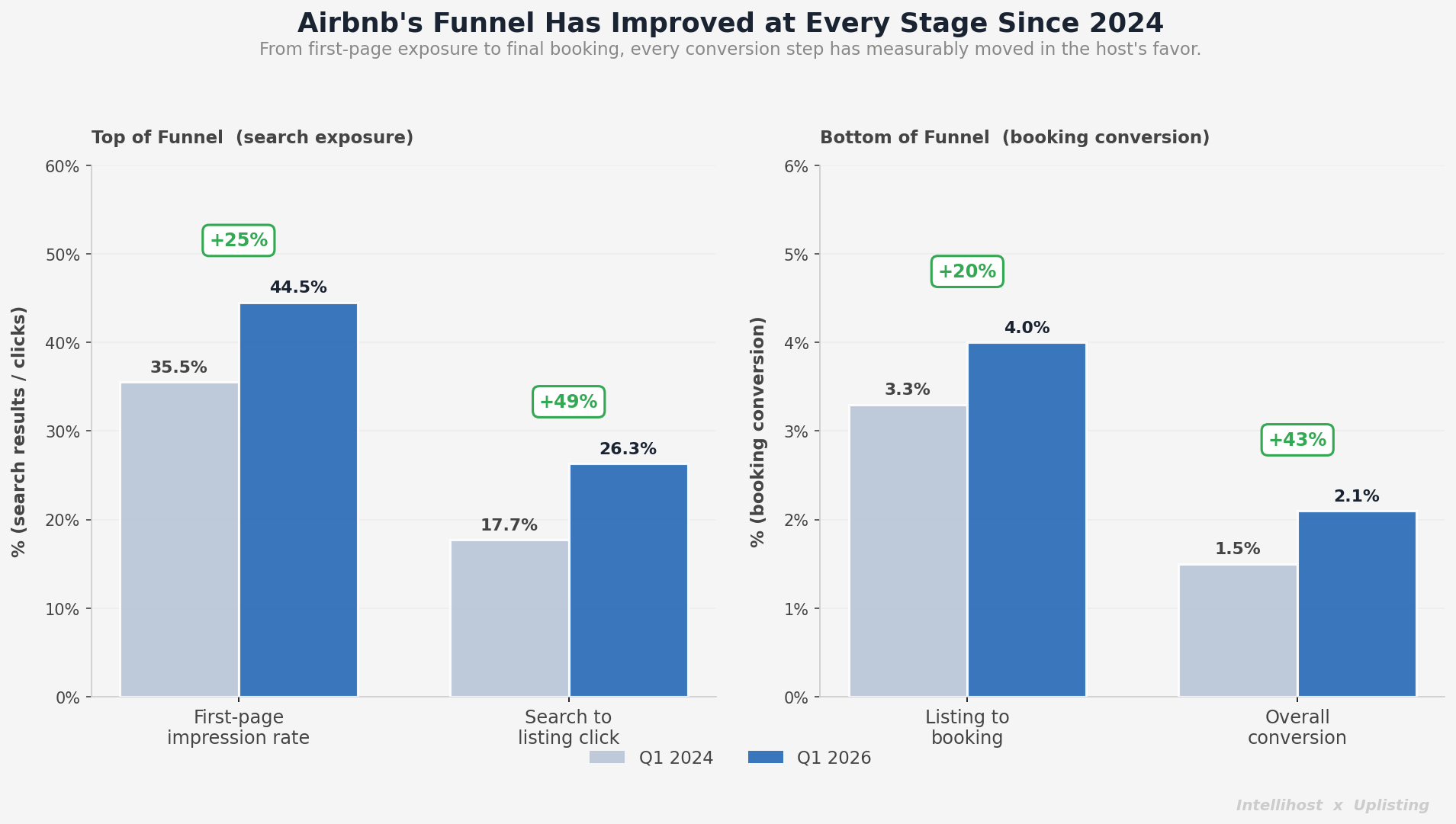
A 2.1% overall conversion rate sounds modest until you do the math on what it means in practice.
If your listing gets 5,000 search impressions across a year — a fairly modest count for a 2-bedroom in any populated US market — you can expect roughly 105 bookings. If those bookings average 3 nights at $200/night, that is $63,000 in gross revenue. To get there, your listing fought thousands of competing listings for first-page exposure, then fought again for the click, then fought again for the booking.
The other implication: there is an enormous amount of "exposure waste" in the Airbnb funnel. About 53% of guests who see your listing on a first-page result never click. About 96% of those who do click never book. Those numbers have not changed structurally even with the recent improvements.
For a host, this means a few things:
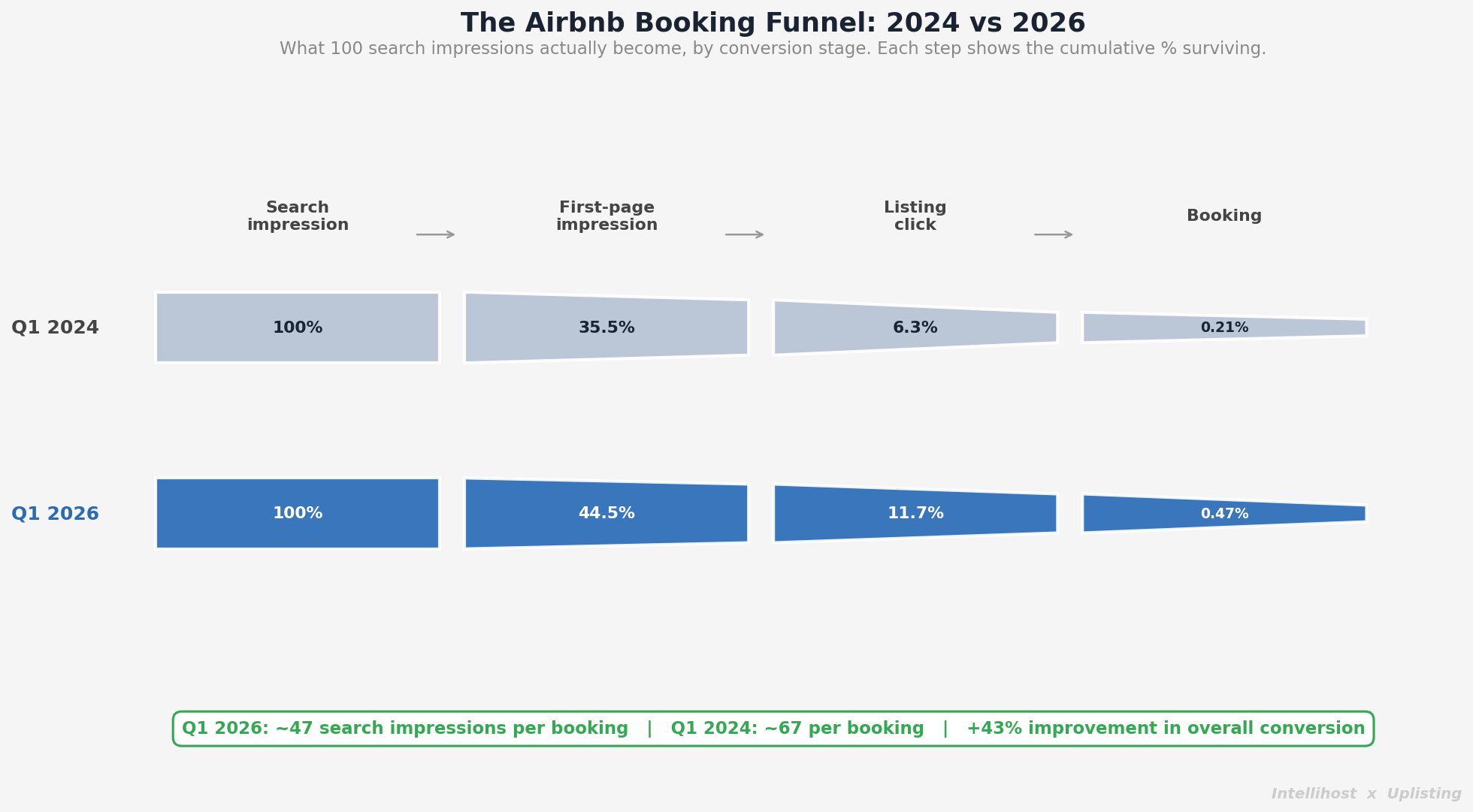
We cannot see Airbnb algorithm directly, but the directional changes are consistent with what they have publicly invested in:
The active listing population in our panel grew roughly 2.4x over the period (about 10,000 listings tracked in 2024 vs. 24,000 in 2026). Some of the apparent improvement could be cohort-mix: listings that joined the panel later may be higher-quality, better-managed properties than the 2024 baseline.
That said, the directional improvement is consistent across all four stages of the funnel. If it were purely a cohort effect, we would expect the lift to concentrate in one stage. The fact that every stage moved in the host favour suggests Airbnb platform is getting genuinely more efficient.

The funnel improvements are doing work for you in the background. Your strategic decisions are still where bookings are won or lost.
Airbnb funnel is getting better, year over year, at every stage. That is good news for hosts who use it well.
But the underlying math — about 47 first-page search impressions per booking — means hosts who depend exclusively on Airbnb for demand are operating at the mercy of small algorithmic shifts that can dramatically swing their visibility. A 25% YoY improvement in first-page impression rate sounds great until you remember that a 25% drop is just as easy to engineer.
The funnel is improving because Airbnb is improving. The hosts who win consistently are the ones who treat that improvement as a tailwind, not a guarantee.
Methodology (powered by IntelliHost)
Funnel data from a panel of 24,000+ US active Airbnb listings tracked over 27 months. Active defined as ≥10 reviews and ≥$10K trailing 12-month revenue. Conversion stages measured as: first-page search impressions ÷ search results shown; listing page views ÷ search impressions; bookings ÷ listing page views. Revenue figures reflect gross booking value, not net to host. Numbers are estimates from public calendar observation — directionally reliable for benchmarking but not audited. Published in collaboration with Uplisting.

.png)