.svg)
Solutions
Features
Resources
.svg)
Trusted by 2,000+ operators
"Whether you have a smaller listing count or a larger one, Uplisting is easy to use, and it's scalable."
Josh Kristoff
Nomad Capital Adventures

4.8/5

4.9/5
Log in to your account
"Whether you have a smaller listing count or a larger one, Uplisting is easy to use, and it's scalable."
Josh Kristoff
Nomad Capital Adventures
Log in to your account

Booking windows across the UK short-term rental market are getting shorter, with many guests choosing to book closer to their arrival date.
For guests, this offers greater flexibility.
For operators, it creates a different set of challenges.
Demand can be harder to forecast, pricing decisions become more difficult and operational requirements can be compressed into a much shorter timeframe.
This report looks at why guests are booking later and what this means for operators managing one or multiple properties.
It covers:
Booking behaviour in the short-term rental market is changing. More guests are choosing to book shorter stays closer to their arrival date, creating what we're calling the ‘late-booking economy’.
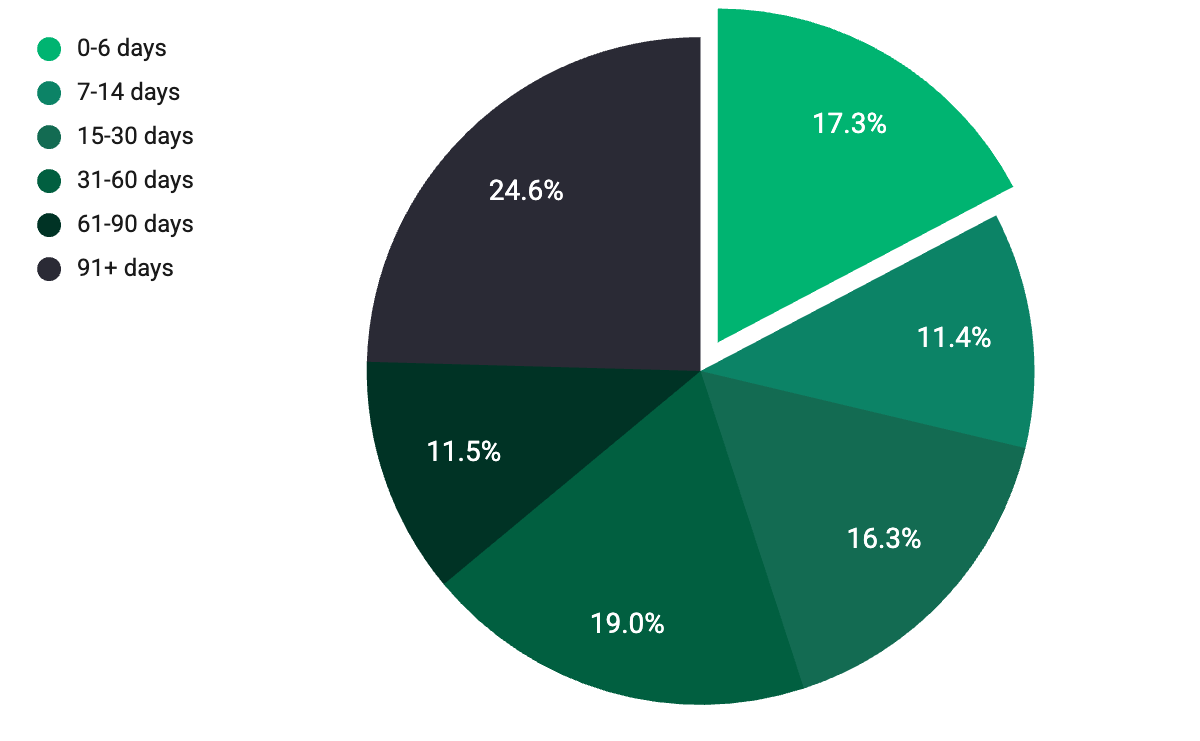
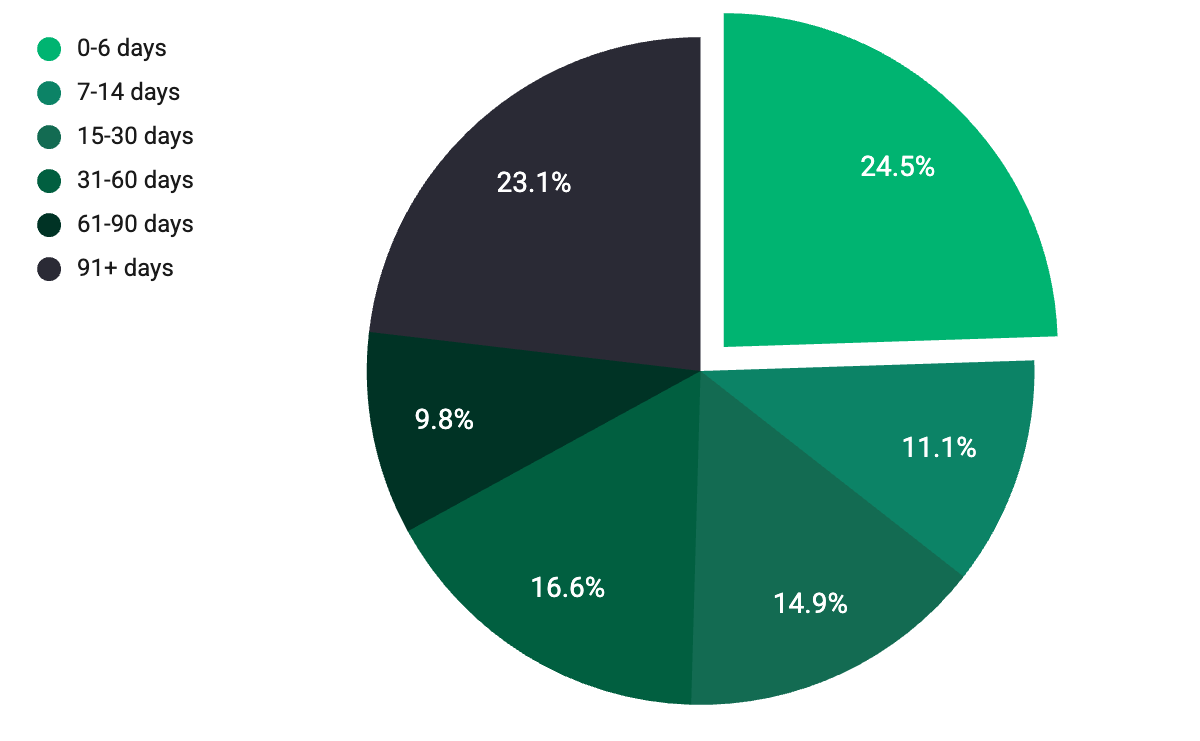
Average lead time (the length of time a property is booked ahead of arrival) has dropped by 7.9% since 2019, with a 7.2% increase in guests booking just 0-6 days before arrival.
This now accounts for nearly a quarter of all bookings by lead time.
2019:
2025:
Source: AirDNA
The shift to shorter booking windows can be seen across the industry, but data shows that some areas are more impacted than others.
The data appear to show that most impacted markets tend to be city regions, rather than more common holiday destinations.
There are several reasons that may be behind this shift, from financial uncertainty to greater flexibility and more ways to book.
Let’s look at each area in more detail.
A research briefing published by UK Parliament shows that:
These factors can all influence booking behaviour and contribute to shorter booking windows.
Guests may be more cautious about committing money months in advance, wanting to ensure their financial situation is stable before making a booking. Holidays become discretionary so even short stays might need more of a ‘wait and see’ approach.
When budgets are tighter, guests are more likely to shop around for the best deal. This takes time so it’s natural for bookings to materialise closer to the arrival date.
For price-sensitive households, waiting can also create an opportunity to take advantage of discounts and last-minute deals.
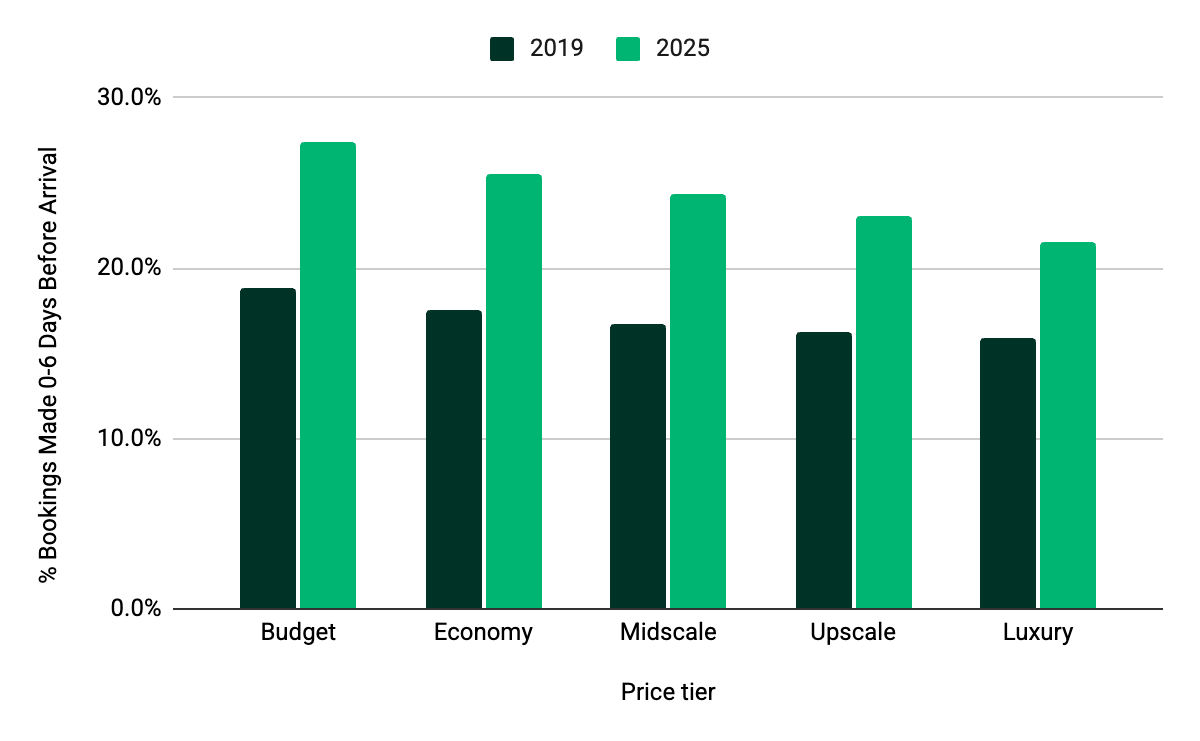
The below graph shows that whilst the percentage of bookings made 0-6 days before arrival has increased across all price tiers, the highest increase is seen for budget accommodation.
It has become easier for people to travel outside of traditional peak periods, especially as remote and hybrid working is now commonplace. When travel no longer needs to fit around fixed periods of annual leave, there is less pressure to plan months in advance.
The STR market is also growing. Since 2019, the amount of available listings within the UK has grown from around 283,000 to over 378,000. An increase of over 33%.
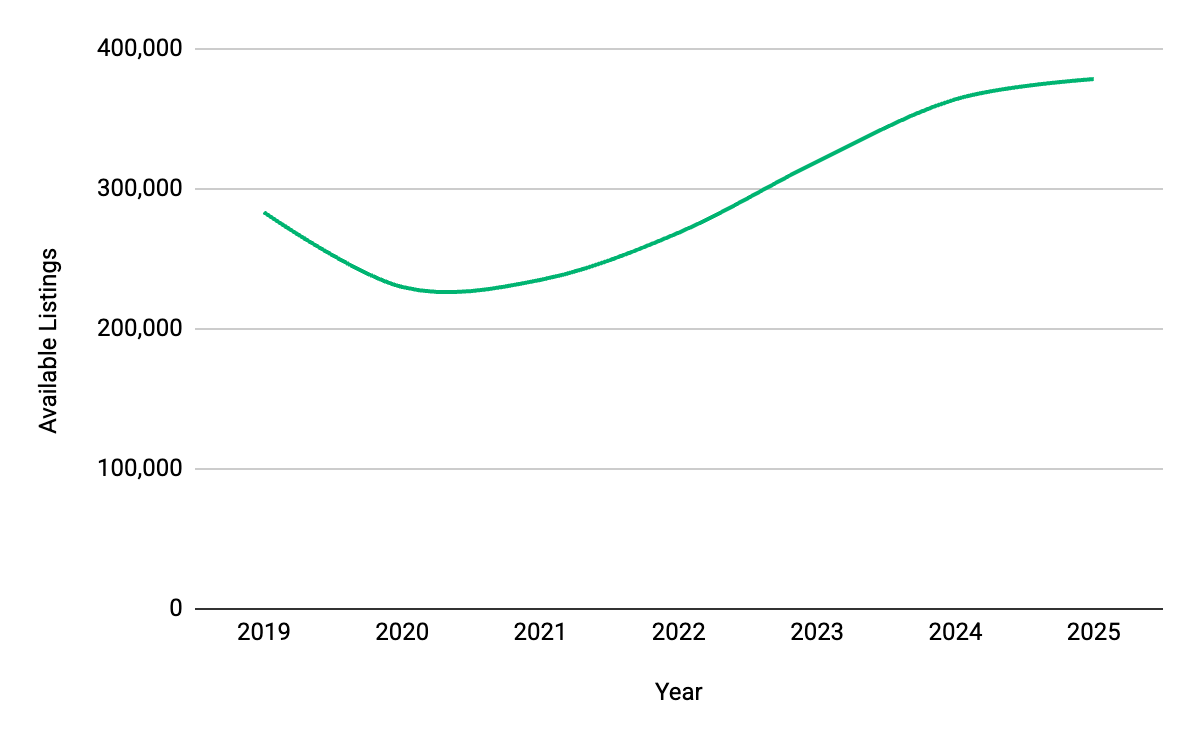
With more properties for guests to choose from than ever before, guests are growing more confident that they’ll be able to find suitable accommodation later.
With this in mind, and increased price-sensitivity for many, guests might choose to wait longer to see whether a better price becomes available closer to their desired date, or may simply keep checking until a cheaper price becomes available and adjust their dates accordingly.
Short breaks are becoming increasingly common.
The amount of short stays (1-3 nights) bookings increased from 6,736,835 in 2019 to 8,913,458 in 2025. A 32.3% increase. The biggest increase was seen for 2 night bookings, rising from 2,659,837 in 2019 to 3,823,358 in 2025. A 43.7% increase.
Shorter stays are easier to organise, require less financial commitment and can be planned around changing circumstances. All of this points to a shorter booking window.
Weather can also influence demand. A good forecast can turn an otherwise quiet weekend into a busy weekend for occupancy. It may look like demand is low, but actually that demand just might not become visible until much closer to the arrival date.
Booking a short break has never been easier. Platforms such as Airbnb, Booking.com and Vrbo allow guests to search, compare and book accommodation in minutes.
Live availability and pricing make it possible to find suitable accommodation at short notice, removing much of the pressure to plan months ahead.
Mobile apps make this even easier. Guests can search, compare and book wherever they are, while saved searches and personalised recommendations keep potential trips front of mind.
When booking is this easy, there is less reason for guests to commit early.
For operators, shorter booking windows can create a number of challenges, from operational uncertainty to loss of revenue.
Shorter booking windows may result in:
Don’t confuse low forward occupancy with low demand. A property at 50% occupancy two weeks before arrival might look like a sign of weak demand, but could fill up closer to the arrival date.
There are a number of areas operators must consider to avoid losing out on key bookings and revenue.
With shorter booking windows, a static pricing strategy becomes risky. If demand arrives late, a rate that was set months ago is unlikely to reflect the current market conditions.
Fixed rates suggest that demand will remain stable throughout the year, which is rarely the case. High prices held for too long may mean properties sit empty if demand never materialises, whilst setting fixed lower prices can mean you secure more bookings but if demand peaks unexpectedly, guests may have been willing to book at a higher rate.
Even if you adopt a seasonal pricing model e.g. higher rates during summer, shorter booking windows mean that demand may no longer follow neat seasonal patterns.
A traditionally quiet period can experience a sudden spike in demand, whilst a peak period can underperform. For example a coastal property will usually perform better over summer, but if we have a particularly wet summer, coastal properties are less likely to be booked.
Bank holidays, events, festivals and good weather can also create demand outside normal seasonal expectations. Previous-year performance can be a good indicator of demand, but operators need to respond to actual demand signals, rather than relying solely on what happened before.
With shorter booking windows, the market can change significantly between setting a rate and the date of stay. This highlights the importance of continually assessing market conditions and adjusting your pricing strategy accordingly.
Platforms like Uplisting can help you do this. You can track how quickly dates are filling and connect market-leading integrations like AirDNA Adapt which will recommend dynamic rates, whilst Uplisting automatically syncs them across all of your booking platforms.
Discounts are a common strategy used in short term rental pricing, and can be a good way to encourage additional bookings when demand is low. However, discounts should be used carefully. Being over zealous with your discounts could mean you reduce prices before you actually need to, and end up losing money.
Discounts should only be used when there is a genuine need to generate demand, not as an ‘across the board’ strategy. Last-minute offers can be useful for filling genuinely at-risk dates, but other useful discounts include length of stay discounts, which encourage longer bookings and reduce operational pressures such as more frequent cleaning and turnovers.
It’s important to avoid a race to the bottom. Competing solely on price is rarely the answer when it comes to generating consistent occupancy.
Holding Your Price
Potential outcome: Demand doesn't materialise. → Empty nights → Lost revenue
Discounting Too Early
Potential outcome: Demand arrives anyway. → Booking secured → Revenue left on the table
It's 14 days before arrival and your property is only 50% booked.
What do you do?
A. Drop the price
B. Hold the rate
C. Increase the rate
The answer? It depends.
Occupancy alone doesn't tell you whether demand is weak.
Before changing your price, it’s important to first understand booking pace. Using tools like AirDNA and KeyData you can compare comparable properties to assess market-wide pace, and if you have YoY data available for your property, you should also look at your pace over the last 7 days compared to the previous year.
Use the matrix below to see what each outcome means for your pricing strategy.
With shorter booking windows becoming commonplace, availability management is more important than ever.
If your calendar is not up to date, and people are looking to book at short notice, you could miss out on bookings.
The shorter the booking window, the less room there is for booking friction. If availability isn't accurate or a guest can't immediately see whether a property is available, they may simply move on to another option.
Ensure that availability is up to date across all of your booking channels. This helps to prevent double bookings.
Our channel management software syncs in real-time so if someone makes a booking, or if you need to adjust property availability, it will automatically update across all of your booking channels.
Later bookings can pose issues when it comes to staffing and cleaning. A shorter booking window means operational demands are often compressed, with less notice for hosting, maintenance and housekeeping teams.
This can cause spikes in workload and put your operational teams under pressure. For those managing multiple properties, it can make coordinating cleans and turnovers especially tricky.
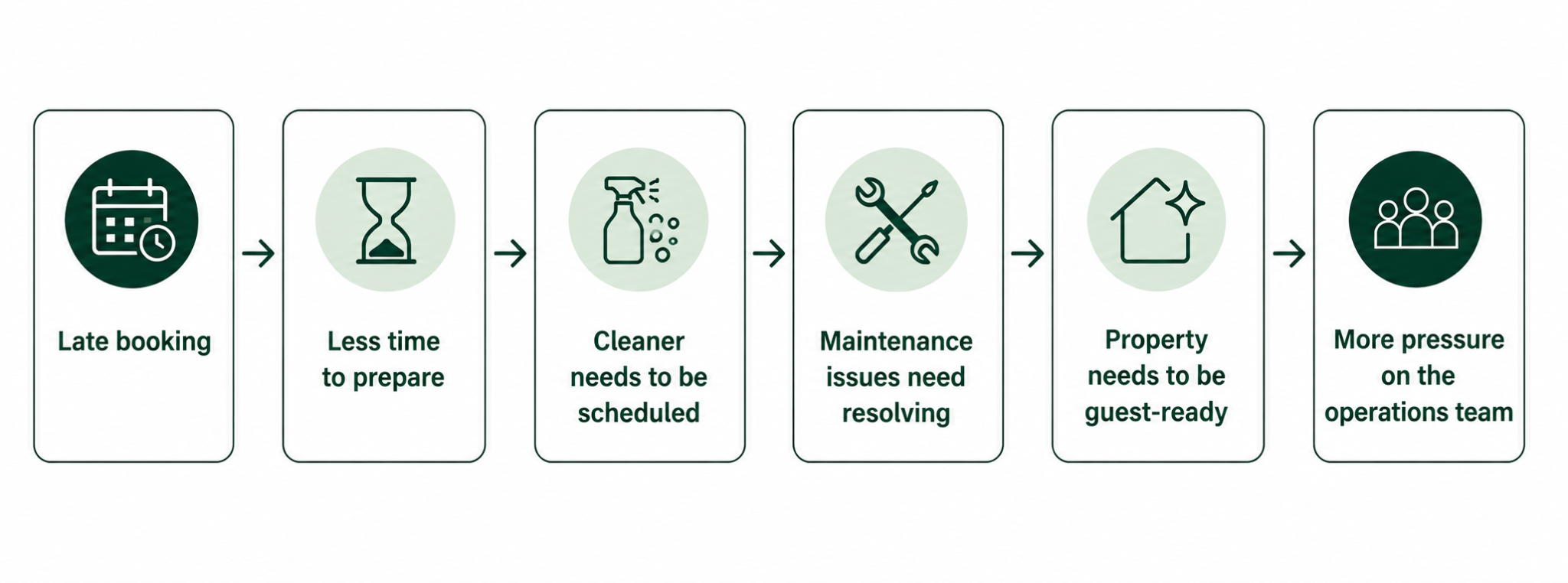
Property managers should try to build operational flexibility into their business.
One way to do this is using tools such as our Cleaning Scheduler, or integrations like Turno. You can add your cleaning teams to your account and tasks will automatically be assigned based on real-time data from your booking calendar.
Guest communication is one of the most time-consuming areas when it comes to short term rental management. When guests book earlier you have more time to get back to queries and send over key information. With a shorter booking window, guests expect and often need faster responses.
Responding to guests more quickly can also help you to secure more bookings and can lead to better reviews.
To reduce operational burden and ensure you can respond quickly to guests even at short notice, you may want to explore automation.
You could create templates for essential communications such as booking confirmations, check-in instructions, pre-arrival information and review requests to speed up comms.
Many platforms such as Uplisting will also automatically populate and send messages based on guest booking information and triggers.
For other common enquiries, our AI messaging feature can help you respond instantly using property and booking details, knowledge base entries, and conversation history to generate personalised responses tailored to each guest enquiry.
For short term rental operators who want to grow their business, it’s essential to adapt to market conditions.
The traditional approach of setting prices, planning staffing and managing availability in advance becomes harder when more bookings are made closer to arrival.
Operators need greater visibility of what is happening across their properties, as well as the tools and processes to respond quickly when demand changes.
Resilient operators tend to share a few common characteristics:
Shorter booking windows don't necessarily mean that operators need to work harder. They mean that operators need to be able to respond faster.
For smaller teams in particular, the ability to automate routine tasks, centralise information and respond to real-time demand can be the difference between constantly having to react to late bookings and being prepared for them.
The booking window for short term rentals is changing. Operators can no longer assume that demand will always be visible months before arrival.
Later bookings aren’t necessarily a sign of weak demand. In many cases, demand is simply arriving later.
This can create a challenge for operators who rely too heavily on static pricing, fixed forecasts and manual processes.
To succeed in these market conditions, pricing should be responsive to what is actually happening at the time, taking into account factors such as booking pace and availability, not just seasonality and previous year’s performance.
Your processes should be flexible enough to handle last minute bookings, turnovers and guest enquiries, without causing added pressure for your operational teams.
The best way to do this is via automation and integrated systems that help you to operate more efficiently, and with more flexibility. The operators who consistently monitor market conditions and adapt to them will be able to make the most of demand, whenever it arrives.
Final Takeaway
The late booking economy has changed when demand arrives. The opportunity for short term rental operators is to make sure your business is ready to act when it does.

.png)